“FREEDOM ADVANCES,” wrote Argentinian president Javier Milei on X/Twitter. “Just what Chile needs,” proclaimed Santiago Abascal, the president of Spain’s far-right Vox party.
On Sunday, far right figures across the world hailed the victory of José Antonio Kast in Chile’s presidential elections. Kast is the son of a Nazi party member who emigrated from the Reich in the wake of World War II, landing first in Argentina and then Chile, where José Antonio was born. Founder of the rightwing Republican party, the three-time candidate has praised Augusto Pinochet, saying the Chilean dictator “would have voted for me if he were alive”.
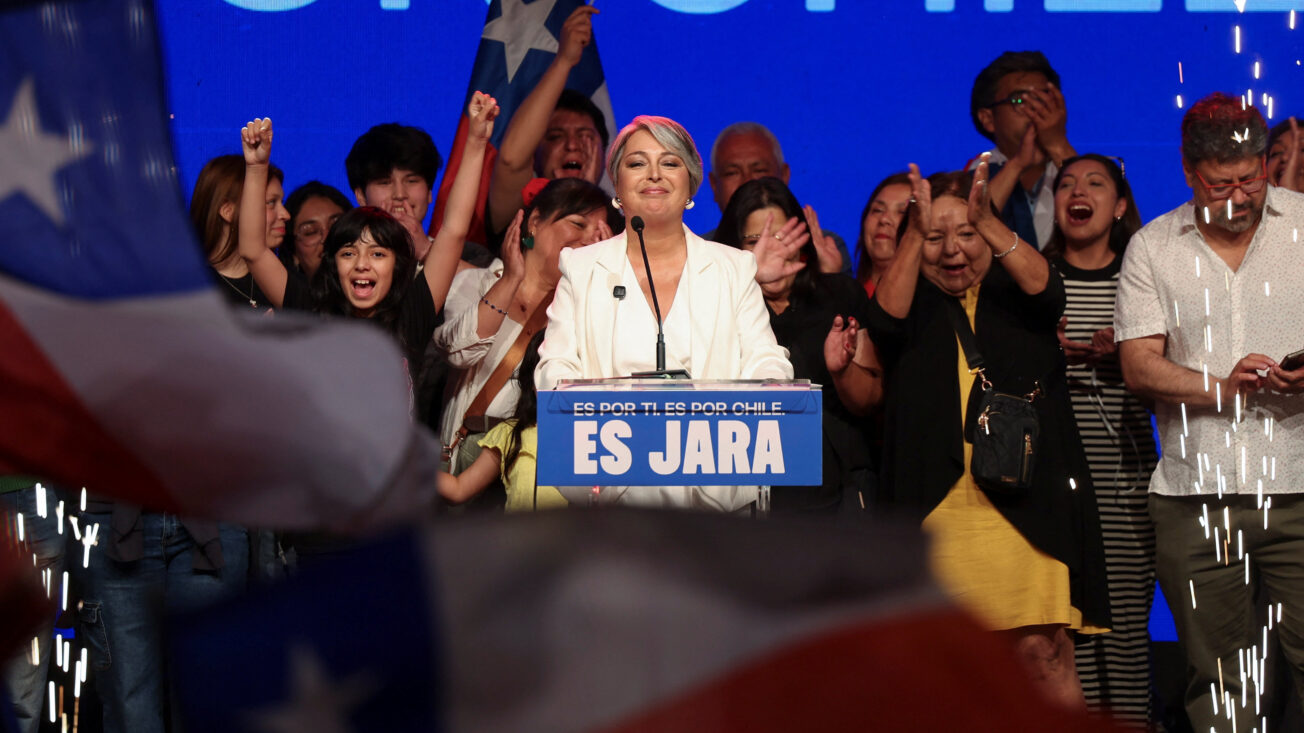
Now, with an overwhelming victory of 58% to 42% over Chilean Communist party candidate Jeannette Jara (who ran on a leftwing coalition platform), Kast will lead the country – a sign that, for many Chileans, Pinochet’s 17-year dictatorship is little more than a distant memory.
“It’s a major step back for Chile,” said María Candelaria Acevedo, a member of the Chilean Communist party who represents the southern Chilean region of Biobío.
In 1983, Acevedo’s father, Sebastián Acevedo, set himself on fire in protest at the detention of his children by Pinochet’s secret police. Human rights groups estimate that more than 40,000 Chileans were detained, tortured and disappeared during the dictatorship. When Pinochet held a referendum on his continued rule in 1988, a majority of Chileans voted no; Kast now becomes the first Chilean president-elect to have voted in favour.
In electing Kast, Chileans have traded the “epic of rights” for the “ethics of order,” said Ana María Olivares Rivas, a journalist and the vice president of the NGO Children and Mothers of Silence, which represents the victims of forced adoption during the dictatorship. In March, Kast will take over from Gabriel Borić, the outgoing leftist president who came to power on a wave of popular revolt that came to be known as the estallido social, or social uprising, but was barred from running again by Chile’s ban on consecutive term limits.
The far right has successfully managed to distance itself from the dictatorship despite being a direct legacy of it, argued Carolina Aguilera, a sociology professor at the Universidad Alberto Hurtado. “For young people in Chile, it’s acknowledged that the dictatorship was bad, but the dictatorship versus democracy axis is no longer a political faultline for the majority of the population because they didn’t live through it,” she said.
Kast ran on a platform of law-and-order in a country where fear of crime is omnipresent. Though the homicide rate in Chile is lower than in neighbouring countries, it doubled between 2019 and 2022 – peaking at 4.6 per 100,000 people. Breathless 24-hour TV channels regularly show news of carjackings and kidnappings, stoking fear of the coastal South American country becoming the next Ecuador, where criminal gangs have gained a foothold in once-safe cities.
“Chile is one of the safest countries in Latin America,” said Claudia Heiss, a political science professor at the University of Chile. “Even so, the rhetoric of fear and a highly security-focused discourse around crime and other issues have been successful in resonating with the electorate.”
Though he has moderated his discourse and backed away from some of his most controversial proposals – including dissolving Chile’s Ministry of Women – Kast remains a radical, far right politician, Heiss assured. His policy proposals include digging a ditch along the border with Bolivia to stem migration flows and deporting 300,000 undocumented migrants, many of them Venezuelan. Like Milei, Kast has also preached the gospel of austerity, promising budget cuts worth $6bn – though it’s still unclear which state agencies will be affected.
“The harshest attacks will be aimed primarily at public-sector workers,” said Gloria Jara, the national director of public-sector workers at Chile’s Ministry of Education. “Our greatest weakness right now is that we have not fully recognised this reality.”
Heiss warned that once in power, Kast might also quickly seek to hamstring state services aimed at “protecting the rule of law and the separation of powers,” such as the Electoral Service. “Far-right agendas in other countries around the world have proven to be a threat to the protection of fundamental rights and to the protection of pluralism,” Heiss said.
To Acevedo, the Communist deputy in Biobío, the first communities that will be affected by a far-right presidency are almost certainly those that are already the most vulnerable, such as the unhoused, the urban poor, migrants, members of the LGBTQ community, and women. In Chile, abortion rights, for example, are protected in certain cases, but legislation is less strong than in neighbouring countries like Argentina.
“Kast belongs to a part of the Chilean far right that has historically opposed every progressive law aimed at affirming and recognising the LGBT community,” Felipe González, a public health specialist in Santiago, said. González, who is gay, worried that Chile’s anti-discrimination law, gender identity law, and programmes to support transgender children, passed in 2019 and reinforced afterwards, could now be chipped away at. Hate crimes against LGBTQ people might also increase – as “often happens when openly homophobic or transphobic sectors come to power”, he added.
On Sunday, hours after Kast’s election, the feminist organisation Coordinadora Feminista 8M published a statement on Instagram calling for a mass general strike on 8 March – international women’s day, and three days before the scheduled transfer of power.
“Pinochet’s heirs have reached La Moneda [Chile’s presidential offices] through the ballot box, not through bombs,” the organisation wrote. “The first and most urgent task of the social and popular movement is to activate our collective strength and build a broad social base of autonomous opposition, capable of mobilising to stop the attacks that are coming.”
Phineas Rueckert is an independent journalist.