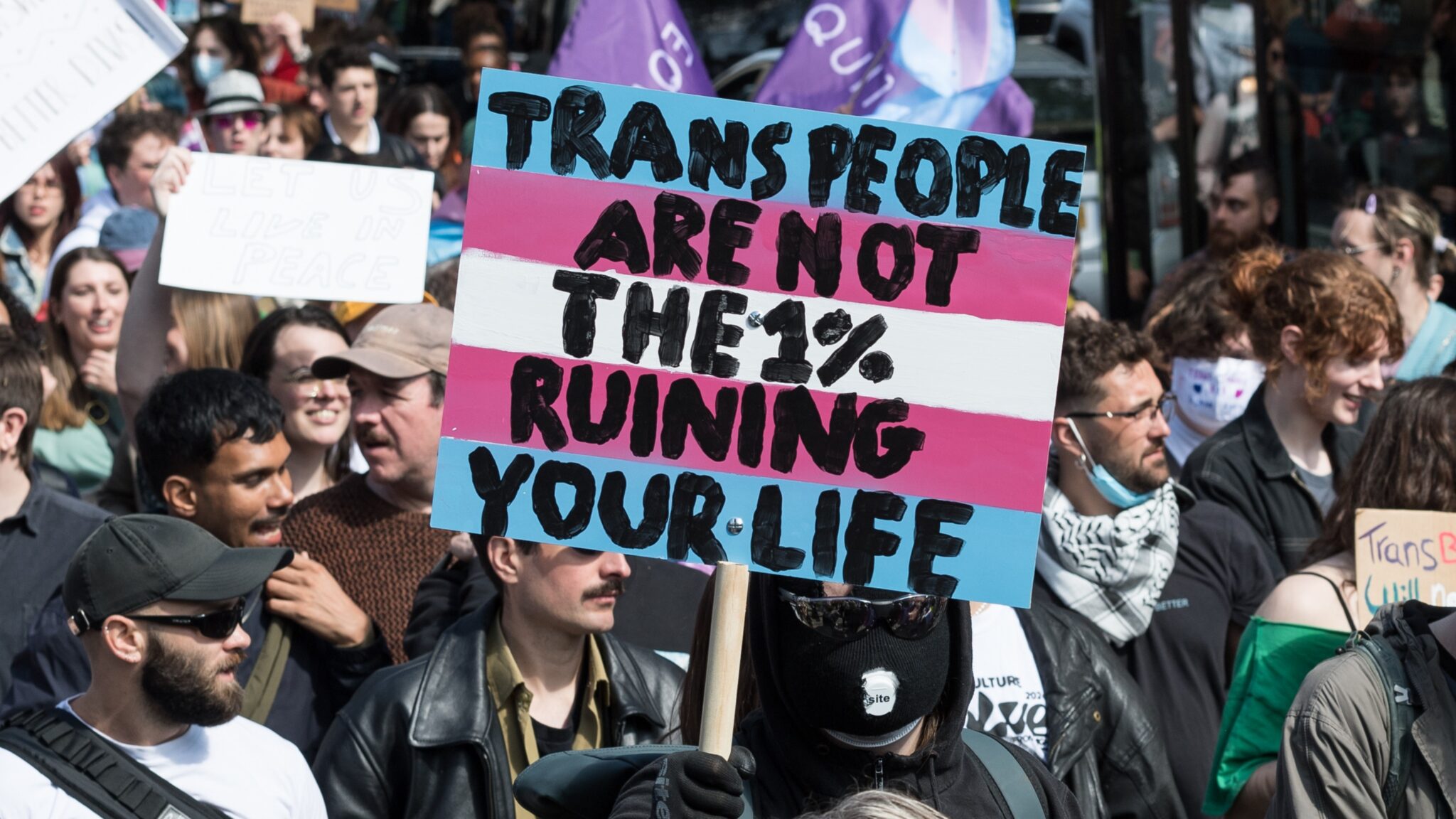
Anti-Trans Groups Want a Bathroom Ban. Judges Aren’t Giving Them One

Shortly before midnight on 24 December 2023, Beth Upton was taking off her scrubs in the women’s changing room of Victoria Hospital in Kirkcaldy on the east coast of Scotland. Upton had just come off a 10-hour shift as a junior doctor in A&E. As she changed alongside two other women colleagues, Sandie Peggie, a nurse in Upton’s department, entered the room.
Upton knew she wasn’t Peggie’s favourite person – she’d noticed Peggie would ignore her, often wouldn’t even look at her. “We don’t have to be friends, just colleagues,” Upton concluded. Upton went into a toilet cubicle and when she emerged, it was just her and Peggie.
I don’t think you should be here, said Peggie, who had deliberately waited for the two other women to leave the changing room so she could confront Upton alone. I’m intimidated by you being in the women’s changing room, she said – because you’re a man.
Upton found herself apologising. I’m sorry you feel intimidated by me, she said, but I’ve been told I’m allowed to change here.
I’ve no problem with you, said Peggie, who in text messages described Upton as “it” and “the weirdo”. I understand you’re going through some process, she said, but you’re not a woman.
Upton went to get her bag. Peggie confronted her.
“What are your chromosomes?”
Upton was silent. She apologised again. This isn’t the right time or place – with minutes to go before Christmas – to talk about this, she said. Peggie pressed harder.
It isn’t just me, she said: lots of people are intimidated by you, and they’re all talking about it behind your back. It’s just that only I have the guts to say it to your face because of my bad history with men.
Upton apologised for a third time, saying she sympathised with Peggie’s experience.
No, you don’t understand, Peggie said. If you sympathised, you wouldn’t be in this changing room. For the fourth time, Upton apologised. Peggie wouldn’t let it go.
Women should be able to feel safe here, Peggie went on. This is just like that person in prison – a reference to Isla Bryson, the trans woman who raped two women in Scotland prior to her transition, and was initially put in a women’s prison before being moved to a men’s facility.
For around five minutes, Upton attempted to exit the conversation, Peggie to keep her in it. Upton felt cornered, though eventually left the room. Upton began Christmas Day in the staff wellbeing room, sobbing to a senior colleague about her ordeal. The consultant put Upton in her car and she went home. Peggie was suspended in January 2024 while the NHS investigated her misconduct, and resumed work three months later, having been placed on a different work pattern to Upton.
Not long after, this short interaction between Upton and Peggie became the basis of a legal harassment claim – not by Upton, but by her harasser.
Peggie’s is one of two high-profile cases against trans inclusion to fail in recent weeks, suggesting that the gender-critical movement bankrolling them may have hit a stumbling block.
Foiled again.
For gender-critical campaigners, Peggie’s was a test case. Specifically, Peggie’s case would indicate whether April’s Supreme Court ruling might enable the exclusion of trans people from single-sex spaces – if not through an act of parliament, like the US bathroom bills, then through employment litigation.
In their ruling, the five Supreme Court justices found that “sex”, “man” and “woman” as used in the Equality Act refer to a person’s sex assigned at birth, not to their gender, even if they have a gender recognition certificate. Gender-critical group Sex Matters responded with a campaign – ‘The law is clear – so get on with it!’ – aiming to use the ruling as a springboard for trans-exclusionary bathroom policies in workplaces and schools. Within days of the ruling, the Equality and Human Rights Commission (EHRC) – whose commissioners previously met with anti-trans campaigners, leading staff whistleblowers to decry an “anti-LGBT culture” – issued interim guidance instructing employers to exclude trans people from single-sex spaces altogether. Just six months later, the guidance was withdrawn, following a legal challenge by the Good Law Project. The commission is currently revising and expanding the draft guidance into a code of practice.
Peggie launched her claim long before the Supreme Court judgement was handed down. Still, gender-critical campaigners made her a poster girl for the post-Supreme Court bathroom bill movement. Representing her was Naomi Cunningham, an employment barrister and former chair of the cisgender rights group Sex Matters. Both Sex Matters and Cunningham relied heavily on the Supreme Court judgement in their arguments, both in court and in public. For Women Scotland, the gender-critical group that brought the Supreme Court ruling, intervened in support of Peggie’s case.
In her case against NHS Fife and Upton, Peggie argued that both parties had harassed and discriminated against her by allowing a trans woman to use the women’s changing rooms. In early December, Judge Alexander Kemp dismissed her claim. The judge found that Upton was not a threat to Peggie’s safety – on the contrary, it was Peggie who had harassed Upton, waiting for her in the toilet cubicle in order to confront her. “It is a travesty that a woman can be judged as having expressed herself in the wrong way when she objects to finding a man in the women’s changing room,” said Sex Matters in a statement.
Peggie’s victimisation of Upton – who was denied anonymity by the court, and has consequently been drawn into a years-long media circus – is not mentioned in the Guardian, Sky News, Telegraph, Daily Mail or Sun‘s coverage of the judgement. The Times mentioned it in paragraph 19 of its report, the Independent in paragraph 23, the BBC in paragraph 32.
“Beth Upton did absolutely nothing wrong, despite being monstered in the press, despite her face being splashed over those tabloids, and her life being made an absolute misery,” Jess O’Thomson, trans rights lead at the Good Law Project, told Novara Media. “I think that has a very chilling effect on trans people’s participation in public life.” One silver lining of Upton’s treatment by the courts, O’Thomson says, is that more of their own trans clients are being granted anonymity, “as judges have seen the absolute circus, and understood trans people might not want to be subjected to that”.
In a statement to Novara Media, NHS Fife said that it had provided Upton with “legal and wellbeing support … throughout the tribunal process”, adding that it “recognises the significant personal impact of sustained media scrutiny on all staff directly and indirectly involved in the tribunal.” Upton did not respond to Novara Media’s request for comment made via her lawyer.
Rather than a case of a cis woman harassing a trans colleague, the case has been widely reported as vindicating Peggie, whom the judge found NHS Fife did harass by taking too long to investigate Upton’s complaint about her; by telling her that her patients were unhappy with her care; and by instructing her not to discuss the case. For this, Peggie may yet receive some remedy, possibly including compensation. On Thursday, the Guardian – whose newsroom has previously been riven over transgender issues, leading to the departure of several of its most prominent gender-critical contributors, as well as a trans staffer – published analysis spinning the case as a “narrow win” for Peggie, adding without citation that “firms that moved early to exclude trans people show no sign of backtracking”.
Yet while gender-critical campaigners appear to be winning over the media, they are failing to persuade judges. For the “huge win” Peggie achieved, according to her solicitor Margaret Gribbon, is decidedly not the one she or her supporters wanted. They had hoped to persuade the courts that the Supreme Court ruling necessitated a bathroom ban. They failed – not once but twice.
Earlier this month, another judge dismissed claims made by a gender-critical employee. Maria Kelly, an engineer for aerospace firm Leonardo UK in Edinburgh, said she was harassed and discriminated against by the company’s trans-inclusive bathroom policy, arguing that putting the privacy of 0.5% of the workforce above 20% of its workplace was unfair. Judge Michelle Sutherland disagreed: only one woman, 0.05% of Leonardo’s female workforce, had complained about trans women’s presence in the women’s toilets, a policy she found did not “put women at greater risk of violence, assault or have a greater impact on their privacy” than men. Judge Sutherland dismissed all of Kelly’s claims. In a lengthy blog post dissecting the decision, Sex Matters called it “a disappointing judgement in defiance of the Supreme Court”, one “based on gender ideology”.
“What [these cases] illustrate is that the law is … not as clear as [Sex Matters] has been asserting,” O’Thomson said. “[Namely] that For Women Scotland requires all of these things [such as trans-exclusionary single-sex spaces policies] … and if you don’t implement [them] immediately, we might sue you. That as a threat doesn’t work as well, when there are now two very well-discussed, long judgments that come to opposite conclusions on the law to where [Sex Matters] sits.”
The failure of these two high-profile cases is a blow to the gender-critical movement, one it’s unlikely to take lying down. The hundreds of thousands of pounds it has spent on Kelly and Peggie’s cases are a drop in the ocean for the well-funded movement, for whom lawfare has become a key weapon in its arsenal. Details of its financial backers and reserves are notoriously murky: Sex Matters, which only registered as a charity last year, is yet to disclose its income; a similar charity, LGB Alliance, reported over half a million pounds in donations at its latest filing. The JK Rowling Women’s Fund, established by the eponymous author in May to support gender-critical legal campaigns, is a private initiative and so not obliged to be transparent, though its sole backer is worth an estimated $1.2bn (£900m) and reportedly donated £70,000 to For Women Scotland’s Supreme Court challenge.
All of this means that neither Peggie nor Kelly needs to take no for an answer. Peggie – described by Rowling as a “heroine” – has said she will appeal the tribunal’s decision, and is separately suing three other NHS officials. It is expected that Kelly will challenge her decision, too, most likely with the financial support of gender-critical groups (Sex Matters did not financially support either Kelly or Peggie’s cases, though it did intervene in Peggie’s).
Yet even if both Kelly and Peggie’s cases ultimately fail at appeal, gender-critical campaigners have several other irons in the fire. Sex Matters is currently taking Hampstead Ladies’ Pond to the High Court over its trans-inclusive entrance policy, while the Christian Legal Centre is supporting five nurses to sue both County Durham and Darlington NHS Foundation Trust for forcing them to share a changing room with a trans woman; a judgement is expected next year.
Yet while BBC reporting hopefully intimates that Peggie’s ruling will bolster those ongoing cases, legal experts who spoke to Novara Media suspect the opposite. They say that the fulsomeness of both Kelly and Peggie’s judgements – 68 and 314 pages long respectively – are intended to preempt the inevitable appeals. “They are very long and careful judgments,” said Robin Moira White, a discrimination barrister at Old Square Chambers who works with trans advocacy group TransLucent, which intervened in Peggie’s case. “Judge Sutherland and Judge Kemp have plainly done that, knowing that there was a pretty much certainty that this would go to appeal.”
Specifically, say lawyers, the judgements are quite explicit about how the Supreme Court judgement does – or rather, does not – impinge on trans people’s access to single-sex spaces, in ways that will hamper future legal action.
No oppression Olympics.
The 2010 Equality Act sets out nine protected characteristics: age, disability, gender reassignment, marriage and civil partnership, pregnancy and maternity, race, religion or belief, sex and sexual orientation. White believes that in Peggie’s case, both she and Upton argued that their own protected characteristics – Upton’s gender reassignment, Peggie’s sex – trumped the other’s.
“Peggie was saying that sex wins out overall, and if it’s a single-sex changing room, then sex determines everything, and trans people shouldn’t be in there,” said White. “And the employer and Upton were saying, ‘Well, hang on a moment. Gender reassignment means I have a right to be accommodated in my reassignment, and that trumps sex.’”
Judge Kemp concluded otherwise.
“There is nothing stated specifically within the act itself, or the court’s decision that one protected characteristic takes precedence over any other,” the judge wrote, citing the judgement in Forstater v CGD Europe and others (the same that led to the foundation of Sex Matters) that “this judgment does not mean that those with gender-critical beliefs can ‘misgender’ trans persons with impunity. The claimant, like everyone else, will continue to be subject to the prohibitions on discrimination and harassment under the [Equality Act].”
“The tribunal said no, both are wrong,” said White. “[Sex and gender reassignment] are both protected characteristics. And what the employer … has got to do is balance the rights … of all groups, as far as they can.”
The judge found that excluding Upton and other trans women from the women’s changing rooms “is clearly liable to amount to indirect discrimination, which is likely to be very hard indeed to justify as proportionate.”
He added that the Supreme Court ruling couldn’t be used to exclude trans women from female changing rooms, as gender-critical campaigners hoped, not least because “the court did not seek to address that question”; the case was about biological sex as defined for the purposes of service provision, not employment. In fact, the judge added, the Supreme Court expressly said that its ruling wouldn’t impinge on trans people’s rights in the workplace or elsewhere: “We have concluded that a biological sex interpretation would not have the effect of disadvantaging or removing important protection from trans people under the [Equality Act] 2010 from trans people (whether with or without a GRC)”.
For O’Thomson, the judgement “wholly undermines the prominent but misleading narrative that the law now requires a trans bathroom ban”.
“We’ve been told that we’re misrepresenting the law [by arguing that the Supreme Court judgement doesn’t necessitate a bathroom ban],” said O’Thompson. “But … we’ve now got two judgments that say we haven’t.”
Sex Matters did not respond to Novara Media’s request for comment.
Running scared.
There is “pressure from the other direction”, White believes. “My experience is [that] employers want to be inclusive, want the best people and want not to be sued.” She recalls the summer of 2020, when Boris Johnson’s government appeared to be getting cold feet over changes to the Gender Recognition Act that would expand trans people’s rights. In response, 132 businesses – including some of the largest in the world – wrote to the government demanding it follow through on its plans. It wasn’t just virtue-signalling, said White. “If you’re [in] a retail environment, you want as many customers as possible. And if you’re an employer, you want access to the widest talent pool so that you get the best employees.” Inclusivity is good for the bottom line.
The damage is already done, however. In October, amidst rampant press coverage of Peggie’s case against it, NHS Fife changed its policy to require that trans staff use the bathroom of their sex assigned at birth. The health board, which employs roughly 8,500 staff, now operates a bathroom ban, regardless of the fact that a court has said it does not need one. Asked by Novara Media whether it would revert to its trans-inclusive policy following the employment tribunal judgement, a spokesperson for NHS Fife said that the health board “regularly reviews its policies and practices to ensure they remain lawful, inclusive, and proportionate”.
Organisations like Sex Matters, said O’Thomson, “often don’t have to sue anyone, they just have to talk about it or threaten it, because all of these organisations know that they just simply do not have the resources to be able to withstand these threats and challenges.” (As of 30 November, NHS Fife has spent £386,423.08 defending the case; others will fold at the thought of spending a fraction of this amount, said O’Thomson.)
O’Thomson points to the recent decisions of Girlguiding and the Women’s Institute to exclude trans women and girls following targeting by gender-critical groups. As well as being modestly resourced, it is not coincidental, O’Thomson added, that both groups are charities, and therefore mindful of “what view the regulator [the Charity Commission] will take of them undergoing organisational risk” by risking litigation as a result of trans-inclusive policies.
“Even though, as far as I’m concerned, their interpretation of the law is wrong, they’re able to create a world in which it’s de facto enforced.”
This, White said, is unacceptable: “It shouldn’t be, should it, that [the] position in UK [law] is determined by which billionaire is going to fund your litigation? That has to be wrong in a civil society, that the right of a nine-year-old trans Brownie in Newport, South Wales is determined by a billionaire in Scotland prepared to fund cases that are negative for trans people. We need the government to rediscover a bit of courage.” She wants “clear guidance”. As things stand, that appears unlikely.
The second draft of the EHRC guidance, leaked to the Times and dubbed by trans campaigners “a misogynist’s charter”, appears significantly more gender-critical than the first. It suggests trans people could be asked about their gender based on their appearance or behaviour. In December, 15 leading charities – among them Samaritans and the Royal College of Psychiatrists – wrote to equalities minister Bridget Phillipson to warn her of the “major risk” the leaked guidance poses to trans people’s mental health.
Asked by Novara Media whether Phillipson would be considering the outcome of Kelly and Peggie’s cases while overseeing the redrafting of the guidance, a spokesperson for the Office for Equality and Opportunity said: “We are reviewing [the draft] with the care it deserves. We have always been clear that the proper process needs to be followed, and we are following it.” Novara Media understands that Phillipson’s office is seeking to balance the need for single-sex spaces with trans people’s right to safety, acceptance, freedom and dignity.
White believes the government is stalling on tabling the guidance in parliament as it is unhappy with the current draft, which it expects will face legal challenge – and because Phillipson has no intention of expending vast political capital on trans rights. Phillipson herself indicated she isn’t in a rush to implement the code, saying that “we want to make sure that women have access to a single-sex provision” and that “trans people should be treated with dignity and respect”.
As for the latter, it is unclear whether they will. Cunningham quit as chair of Sex Matters shortly before the Kelly and Peggie judgements were issued (Cunningham represented both women). In his judgement, Judge Kemp found that Upton had been mistreated not only by Peggie, but by Peggie’s barrister. Cunningham referred to Upton as a man throughout the trial – a decision which courts permit when someone’s gender is at issue, but which the judge said “the second respondent considers misgendering and offensive, and in other contexts could be held to be harassment under the [Equality] Act.” In an email to Novara Media, Cunningham said: “It is not my habit to comment to the media on cases in which I am instructed as counsel.”
“The cross-examination went to the heart of how the second respondent held a sense of identity. In the context of the present dispute that was legitimate cross-examination but we noted that the second respondent was affected by that, even if there was a clear attempt not to show that.”
Judge Kemp also noted that during her cross-examination of Upton, Cunningham asked a question comparing the doctor to a torturer in George Orwell’s novel 1984. In the novel, Cunningham reportedly said, high-ranking party official O’Brien interrogates the protagonist, Winston, forcing him to agree that the four fingers he is holding up are in fact five, the “ultimate torture” in making Winston say something they both know is untrue. Wasn’t Upton’s insistence to Peggie that she is a woman comparable? Cunningham asked Upton, who was visibly shaken. The question was withdrawn after an objection from Upton’s lawyer, who suggested the comparison was worse than Peggie’s comparison of Upton to rapist Isla Bryson.
“Despite how it’s been presented, this is pretty substantive condemnation of where gender critical campaigners have found themselves, both in terms of their conduct and in their legal analysis,” said O’Thomson.
Cunningham denied to Novara Media that her departure as chair of Sex Matters was related to her conduct in Peggie’s case. She declined to say what prompted her resignation.
Correction, Wednesday 17 December: The article has been updated to reflect that on Thursday 11 December, the tribunal in Sandie Peggie’s case issued a certificate of correction replacing one paragraph of the original judgement, which we quoted in the original version of this article. That paragraph included a quotation from Forstater v CGD Europe that did not appear in the judgement. We have therefore removed it from our report. The amended judgement quoted a different, similar section from Forstater v CGD Europe, which we have instead cited.
Rivkah Brown is a Novara Media commissioning editor and reporter.