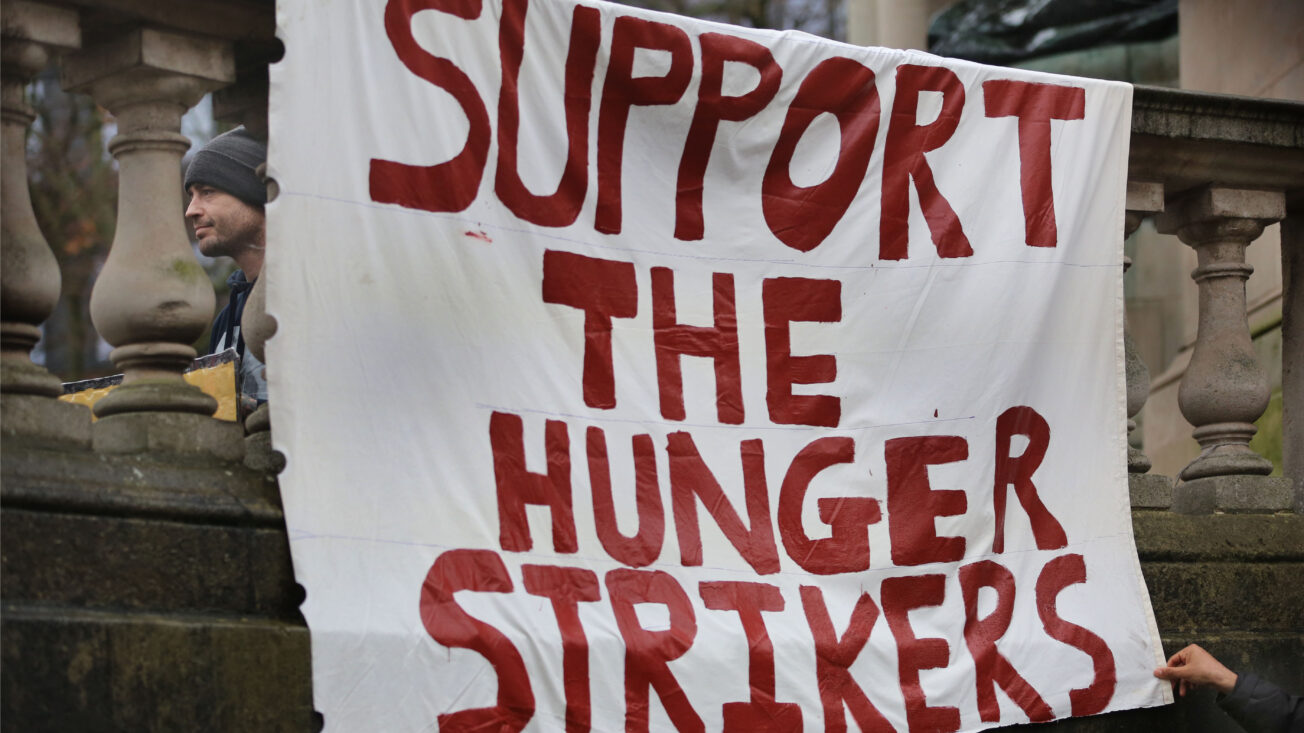
Palestine Action Hunger-Striker Hospitalised With Heart Muscle Shrinkage
Another has refused food longer than 80% of Irish republican hunger strikers who died in 1981.
by Harriet Williamson
8 January 2026

A Palestine Action-linked prisoner on hunger strike has been hospitalised with shrinkage of his heart muscle, while another has gone without food for longer than 80% of Irish republican hunger strikers who died in 1981.
Kamran Ahmed, 28, has gone 60 days without food, whilst Heba Muraisi, 31, is on day 67. Both are at a critical point in their hunger strike, and medical professionals say they are at risk of imminent death.
Ahmed was hospitalised for the sixth time on Wednesday 7 January. Ahmed is experiencing shrinkage to the muscle of his heart and has been diagnosed with bradycardia, with his heart rate dropping to 40bpm, his sister Shahmina Alam, who is a pharmacist, told Novara Media.
“There are significant changes to his ECG putting him at risk of sudden cardiac arrest,” Alam said. “The government must act now.”
Both Muraisi and Ahmed are “well into that critical phase now where something really catastrophic could happen,” Dr James Smith, an emergency doctor and University College London lecturer, told Novara Media.
Ahmed and Muraisi are two of eight prisoners who have taken part in the rolling hunger strike while being held on remand for alleged offences related to Palestine Action activism. The pair have been imprisoned without trial for over 13 months – far beyond the pre-trial custody limit of approximately six months.
Muraisi is experiencing symptoms including breathlessness, muscle spasms, severe pain and a low white blood cell count. Ahmed has reported breathing difficulties, severe chest pain, and intermittent hearing loss. Smith called reports of his hearing loss “very concerning” and said it “could well suggest damage to the nervous system”.
The hunger strikers’ demands are for a fair trial, immediate bail, the deproscription of Palestine Action under UK terror law, for all sites of Israel’s biggest arms company Elbit Systems to be shut down in the UK, and for prisons to stop withholding the hunger strikers’ communications.
This is believed to be the largest coordinated hunger strike in the UK since the 1981 Maze prison hunger strike where ten Irish republican political prisoners died. Of the ten prisoners who died, only two went longer without food than Muraisi.
Smith said: “Beyond approximately week four of a hunger strike, you have exhausted your short term energy reserves and your fat stores, and you are breaking down muscle and organ tissue in order to generate enough energy to maintain those kinds of core bodily functions.”
Muraisi, who is from London, was moved hundreds of miles away from her disabled mother and support networks back in October, from HMP Bronzefield in Surrey to HMP New Hall in West Yorkshire.
Muraisi maintains that she will not end her hunger strike until she is returned to Bronzefield. Due to icy weather, snow and Storm Goretti, it is becoming increasingly difficult for supporters and southern-based journalists to access New Hall.
To any “cynics on social media” speculating about whether Muraisi and Ahmed are eating in prison, Smith pointed out that people “react physiologically very differently” and that the age and preexisting health conditions or lack thereof of the hunger strikers are major factors.
Smith also told Novara Media that medical advancements over time and the hunger strikers receiving vitamin and thiamine replacements “may well be staving off some of the negative consequences that we would expect from electrolyte and micronutrient deficiencies”, but long-term physical consequences for the hunger strikers could materialise many years or decades after the strike comes to an end.
The eight Palestine Action-linked prisoners who have taken part in the hunger strike are Lewie Chiaramello, who has been intermittently fasting for 46 days because he has diabetes; Teuta ‘T’ Hoxha who paused her 58-day hunger strike (the second she has undertaken in less than a year) on 5 January and is currently undergoing refeeding; Qesser Zuhrah and Amu Gib who paused their strikes after 51 days on 23 December; and Jon Cink and Umer Khalid who also ended their 41-day and 13-day hunger strikes earlier last month.
Prisoners who have paused their strikes are not out of danger either.
Nida Jafri, the best friend of Amu Gib who is currently held in HMP Bronzefield, told Novara Media that Gib is still physically “very weak” and is “slowly gaining the ability to walk again”.
Jafri said: “Amu and Qesser were discharged from hospital prematurely, in contradiction to medical advice. The refeeding process is supposed to take place under medical observation in a hospital. More or less each hunger striker has required substantial phone blockades and MP interventions to even gain hospitalisation for refeeding.
“Amu has no advice on refeeding right now. They’re left to use their own judgement to figure out how much and of what food they should eat. We, as loved ones, are terrified of this. We are aware that the reintroduction of food can be deadly if done incorrectly.”
An HMP Bronzefield spokesperson said: “All prisoners are managed in accordance with the policies and procedures governing the wider UK prison estate. Whilst we cannot provide information about specific individuals, prisoners’ wellbeing is continually assessed, and appropriate action is taken where required. Any prisoner who resumes eating after food refusal receives regular medical assessment and support in line with established policy and with full regard to prisoner rights. Healthcare provision within the prison is delivered by the NHS, and prisoners have full access to clinical care, including specialist and external services where necessary.
“If any prisoner has specific complaints, we encourage them to raise them directly with the prison, as there are numerous channels available for addressing such concerns.”
The Ministry of Justice and Number 10 Downing Street have been approached for comment.
Harriet Williamson is a commissioning editor and reporter for Novara Media.