Rojava Is Fighting for Its Life
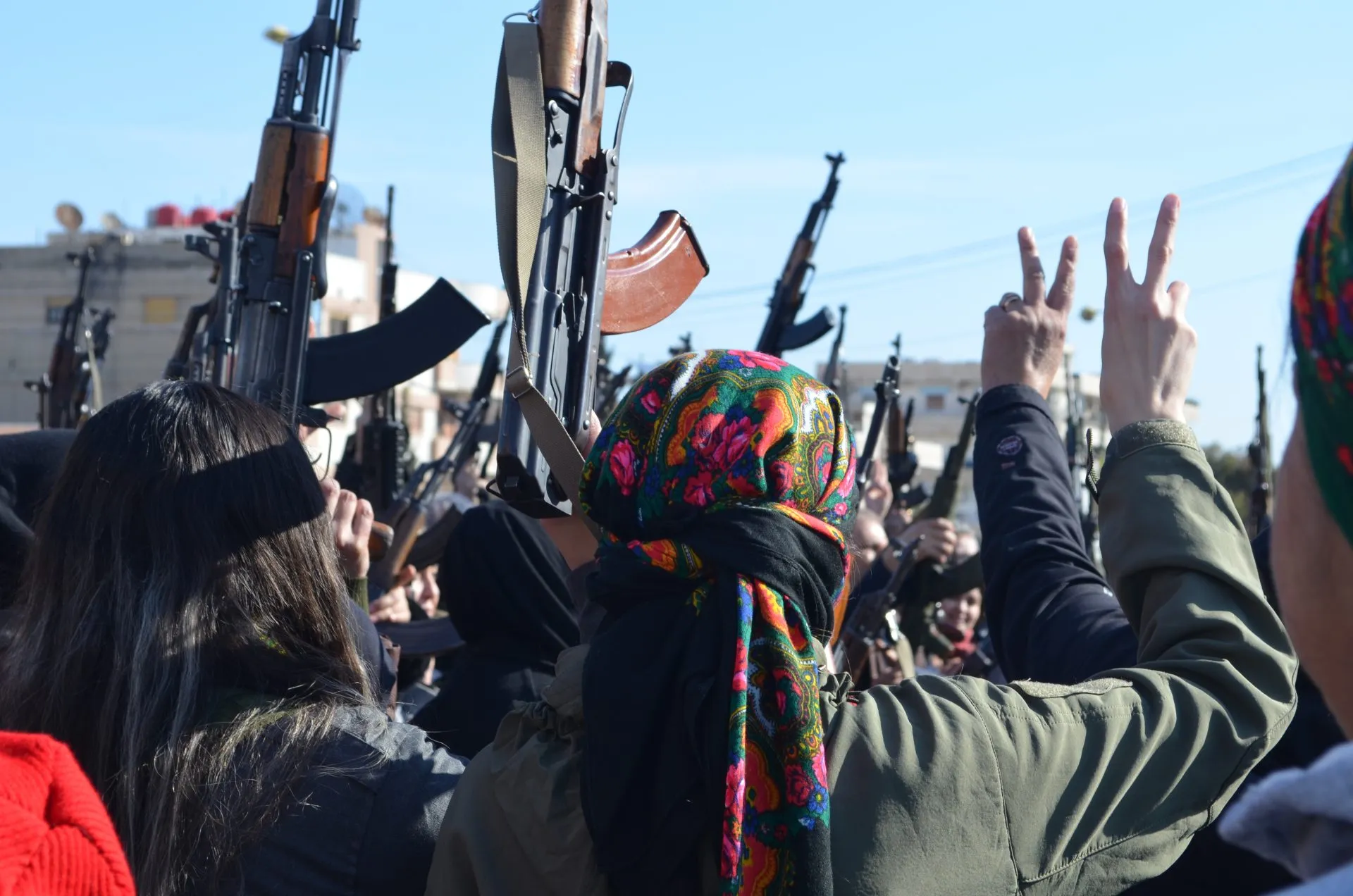
In a late night call with Novara Media on Monday, a source in Rojava, the semi-autonomous, socialist and democratic Kurdish territory in north-eastern Syria, described the situation on the ground. The call was hurried and intense, amid fears that the Syrian authorities might cut the internet, as the government of Iran had done a week earlier in the face of revolt. “It’s an existential war,” the source said. “But the revolution is not lost.”
Earlier that day, the Syrian army, fighting on behalf of the Syrian transitional government, led by the country’s interim president former-jihadist Ahmed al-Sharaa (also known as al-Jolani) had attempted to take control of two prisons in Kurdish-controlled cities, holding as many as 8,000 Isis prisoners. In Hesekeh, Shaddadi jail was taken. Outside Raqqa, Syrian Democratic Forces (SDF) – effectively Rojava’s military – managed to hold al-Aqtan prison against the Syrian army and aligned fighters, despite tank-shelling. It came, though, at a cost: dozens of SDF fighters are said to have been killed.
In Shaddadi, the cost may yet be higher. The Syrian transitional government reported that around 150 Isis prisoners were freed by the SDF, and instituted a curfew in the city previously under Kurdish control. In the wake of a call for mass civilian mobilisation by the Rojava authorities, that curfew may have served a double-purpose. And according to the SDF, it was the Syrian army that released the Isis prisoners. Not 150 of them, but 1,500.
It’s difficult to verify these figures, but in 2025 a report to the US congress confirmed roughly 8,950 Isis prisoners held in SDF-controlled prisons. In 2023, a Rand Corporation study found that two thirds of that total number were held across two prisons: Shaddadi and al-Hasakeh Central Prison. It is not, therefore, implausible to suppose that Shaddadi held at least 1,500 prisoners. On Monday, a reporter for Emirates paper The National described Shaddadi as “completely empty”.
In response to the renewed threat from Isis, neighbouring Iraq has fortified its border with Syria. But according to our source, none of this should have been necessary.
Just two kilometres away from Shaddadi prison lies one of the bases of the international coalition, comprising US, British and French forces previously allied with the SDF in the battle against Isis in the region. Ahead of an agreement, signed on Sunday, to hand control of the prisons to the Syrian transitional government, the SDF had reportedly been in negotiations with the coalition to agree a plan for the removal of high-value Isis prisoners to more secure locations amidst the possibility of a security vacuum.
The coalition never enacted those plans. Nor, Novara Media has been told, did the coalition respond to repeated calls from the Kurdish authorities to assist with the breach of Shaddadi prison – and the almost-breach of the Raqqa prison – on Monday.
By Wednesday evening, the Raqqa prison, housing around 2,000 Isis prisoners, appeared to have been taken by the Damascus-aligned forces too. Also on Wednesday night, in a possible sign of mistrust in the Syrian transitional government’s ability to manage the Isis prisoners, US Central Command said it would now begin transferring thousands of them from facilities in Syria to Iraq.
‘No friends but the mountains.’
For several years from around 2015 onwards, the Women’s Protection Units, or YPJ, consisting of mainly Kurdish, but also many Arab, women fighters, were feted in western media. Barely a month passed without glossy photo-spreads of girls with guns in Iraq and Syria fighting the theocratic and murderous misogyny of Isis. From Vogue to the Guardian, from Time Magazine to Marie Claire, the Kurdish resistance, led by revolutionary women, was front page news.
That was not without cause. In 2014, Isis put the city of Kobani and its surrounding geography, perched on Syria’s border with Turkey, under siege, soon generating almost half a million Kurdish refugees who fled into Turkey. But in a street-by-street battle by YPJ fighters alongside the male-led People’s Protection Units (YPG), Kobani city was, eventually, liberated.
In the interim, the US got involved, co-ordinating airstrikes with Kurdish fighters to help clear a path to the city’s liberation. Sometime in 2015, firmer cooperation between the US and the YPG (now a name that included the YPJ, and since all folded into the SDF) was established, with the US providing the Kurdish forces with arms. Around the same time – though the dates are sketchy – a wider western coalition including the UK came to understand that Kurdish fighters in north-eastern Syria were the most effective on-the-ground resistance to the spread of Isis, all but snuffing it out in the region by 2019 at the cost of 12,000 SDF lives.
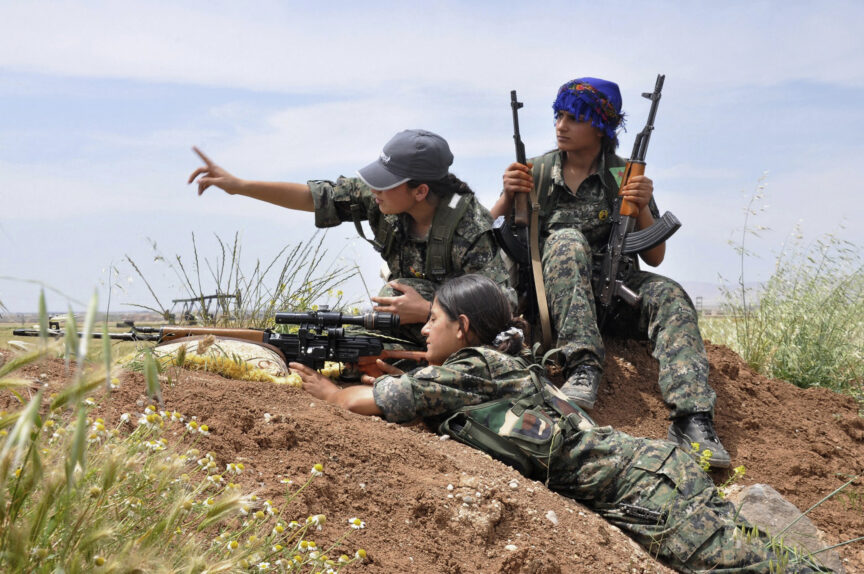
Less reported, however, was the political model that underpinned an emergent Rojava. Secular, multi-ethnic and multi-religious, regularly women-led and underpinned by libertarian-socialist principles, its politics were detested by Isis. But it also created a difficult configuration for other players in the regions – as well as the YPG’s allies.
For Turkey, pursuing a Turkish ethno-nationalist agenda under President Recep Tayyip Erdoğan, the Kurds and their aspirations are a persistent irritant. For the US and its allies, the socialist policies of the SDF and the Rojava authorities were only ever tolerable so long as Kurds were putting their lives at risk in pursuit of western goals. Skipping forward to today, for the new Syrian transitional government, led by recent jihadists in Damascus, a powerful and often women-led force situated via communities and councils in roughly one-third of the country’s territory, may be impossible.
But an alignment of immediate interests saw western powers, surprisingly, supporting and protecting a revolutionary force from regional enemies, including ally and Nato-member Turkey. In late 2024, Syria’s former president Bashar al-Assad was deposed by Sharaa and his force Hay’at Tahrir al-Sham (HTS), which now leads the Syrian army. Many – including US president Donald Trump – believed Sharaa’s victory relied on Turkish assistance.
Feted by western leaders and media, Sharaa’s ascension saw Turkey return to dominance in the region. The second election of Trump also saw the US reorient itself towards Ankara, with the White House appointing billionaire Tom Barrack as both ambassador to Turkey and special envoy to Syria. Barrack, who was accused, and then acquitted, of being an Emirati agent during the first Trump administration, has, in recent days, made clear that the temporary alliance of the West with Rojava is over – as, it seems, is its protection.
Which may explain videos, believed by the Rojava Information Centre to be authentic, posted online in recent days. They show the beheading of a woman SDF fighter, the throwing of the body of another – Deniz Çiya – from a building, and the kidnapping and sexualisation of two others by government soldiers.
Under siege once more.
In the last two weeks, the Syrian transitional government has taken large parts of previously SDF-controlled territory in the country’s north-east, but not without resistance. In Aleppo, just 900 SDF fighters are reported to have held off 42,000 government forces over a five-day battle, before withdrawing. That retreat followed discussions with international parties, according to SDF commander Mazloum Abdi.
But according to Novara Media’s source, it wasn’t just the Syrian army fighting for Damascus. They say fighters in Isis uniform were also present, as well as Turkish mercenary fighters, some of whom wore the insignia of the Grey Wolves, a group described as a fascist militia. Turkey is also said to have conducted air and drone strikes against SDF positions in Aleppo and elsewhere.
A similar situation is unfolding in Kobani where, despite reports of a ceasefire on Tuesday night, a siege by Syrian government forces is ongoing, with internet and electricity to the city cut. Kobani, unlike many of the other former SDF-governed cities and towns so far taken by Syrian government forces, is Kurdish majority, leading to fears of massacres if it falls.
Those fears of mass-killings of a non-Arab minority may not be misplaced. Last year, Syrian forces killed hundreds of civilians of the country’s Alawite minority. Also last year, government-aligned forces were accused of carrying out extrajudicial killings of civilians belonging to the Druze minority.
On Wednesday, the Syrian army took control of the Al Hol camp from the SDF. Located on Syria’s border with Iraq, the camp houses more than 40,000 people – many of them the wives and children of killed or captured Isis militants.
Further north is the Al Roj camp, for now still under SDF control. One of its more famous residents is Shamima Begum who, as a 15-year-old, left Britain to become a child-bride to an Isis commander. Formerly a British citizen, that status was revoked by the government in 2019.
Like Begum, many of Al Roj’s 2,500 residents are foreign nationals and their children, whose home countries have refused them repatriation, leaving them in humanitarian danger and political limbo. Since the routing of Isis in 2019, it has been the SDF that has administered the vast and sometimes dangerous problem of captured Isis fighters and their families on behalf of wealthy nations and against what SDF spokesperson Farhad al-Shami on Wednesday called a backdrop of “international indifference”.
That international indifference shows no sign of abating. On Tuesday night, the government in Damascus announced a four-day ceasefire with the SDF. According to Novara Media’s source, there is no sign of government-aligned forces heeding it. For their part, the SDF has said it will only occupy defensive positions against government forces, and won’t attempt to take back lost territory.
But even if Damascus – now vastly empowered by the US and Turkey – were to enforce a ceasefire in the north-east, there is great fear not only for Rojava as an idea, but for the thousands of Kurds in the territory. With potentially hundreds of Isis militants released into the area, as well as barely controllable Islamist and Turkish fundamentalists among the ranks of those fighting for Sharaa, bloodbaths may soon begin in Syria once more.
Steven Methven is the editor of Novara Live, Novara Media’s nightly news and politics YouTube show.


