UK Gave £90k to Sexual Violence Report Central to Israel’s Genocide Propaganda
The UK gave £90,000 to an Israeli report seeking to prove that sexual violence by Hamas on 7 October was “systematic”, a weakly evidenced claim Israel made central to justifying its genocide in Gaza, Novara Media can reveal.
In September 2024, Israeli government-aligned research group The Dinah Project applied to the Labour-run Foreign, Commonwealth & Development Office (FCDO) for funding for a report seeking to establish the “systematic and premeditated nature” of Hamas’ sexual violence during and after the 7 October attack.
Following a seven-month battle with the FCDO, Novara Media has been partially granted its freedom of information (FOI) request, indicating that the department, then overseen by David Lammy, granted The Dinah Project £90,000, 75% of its budget for the four-month project. An Israeli official went on to describe the report as “a significant public diplomacy tool for us”.
The revelation has drawn criticism from civil society and human rights groups, who have noted that the UK government has ignored the growing body of evidence of Israel’s systematic sexual violence towards Palestinians during the genocide.
‘A violent horde that lacks any moral restraint.’
The Dinah Project’s 84-page report, titled “A Quest for Justice: October 7 and Beyond”, was published in July 2025, amid mounting international pressure on Israel to end the Gaza genocide.
The report, which lowers evidentiary standards for establishing sexual violence in conflict, found that “sexual violence was widespread and systematic” on 7 October and identified “clear patterns” in its perpetration. It concluded that Hamas tactically deployed sexual violence as a “weapon of war”.
Though presented as an academic paper, the report has an inflammatory tone, describing “those terrorists who participated in the attack on October 7” as “a violent horde that lacks any moral restraint”.
The Israeli government has since made The Dinah Project’s report its main source for systematic sexual violence by Hamas, centring it in a multi-million-pound propaganda campaign. In a Knesset (Israeli parliament) debate, an official openly praised the report’s role in shoring up the country’s reputation during the genocide.
Last summer, journalists noted that the UK had financially contributed to The Dinah Project’s report. Novara Media FOI requested specific data, which the FCDO denied. Novara Media escalated the matter to the Information Commissioner’s Office, which granted the information. The process of extracting the information took seven-months in total.
“What is shocking is the government’s lack of transparency,” said Chris Doyle, director of the Council for Arab-British Understanding. “Why did it seek to hide its support for The Dinah Project?”
‘The campaign was disseminated by all the means we have as a state.’
The Dinah Project was launched in 2023 as a woman-led “research and legal initiative”. It is named after the first victim of rape to be recorded in the Old Testament and housed within The Ruth and Emanuel Rackman Center for the Advancement of Women’s Status, part of the law faculty of Israel’s Bar-Ilan University. Based just east of Tel Aviv, Bar-Ilan is widely seen as right-leaning and religiously orthodox: Yigal Amir, the Zionist extremist who assassinated prime minister Yitzchak Rabin in 1995, was a student there. Today, the university describes itself as “a critical ally for the government of Israel in its quest to … maintain its defensive edge”.
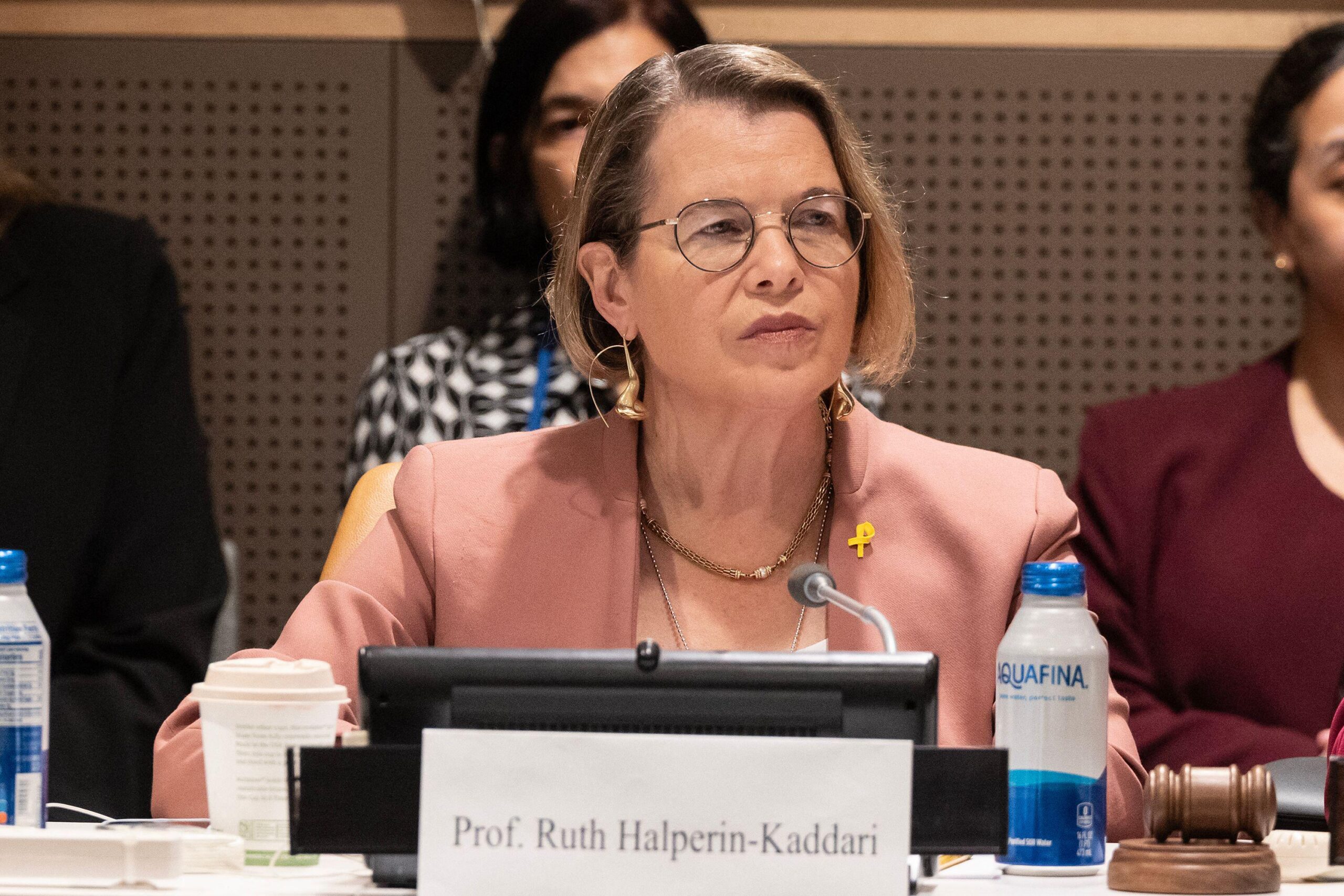
The Dinah Project’s co-founder is the IDF’s former chief military prosecutor, reservist Col Sharon Zagagi-Pinhas. Its advisory board includes former Israeli ambassador to the UN, Aharon Leshno-Yaar, and ex-president of Israel’s supreme court, Dorit Beinisch; other board members include prominent Israeli actress Gal Gadot, and Noa Tishby, former government envoy for combating antisemitism.
In its application to the FCDO The Dinah Project claimed that the organisation has “no formal connection or relationship” to the Israeli government. It said its research “will operate in parallel to the Israeli government’s investigation of these crimes and response thereto”. The first beneficiary group listed in the organisation’s funding application to the FCDO, supplied to Novara Media in its FOI request, is redacted; the second is “Israeli society at large”.
Meanwhile, the Israeli government has been open about its close ties to The Dinah Project and the integral role its report played in hasbara (Hebrew for state propaganda). The Knesset’s foreign policy committee even convened a debate to mark the report’s launch. “This is an important and significant project that serves as a significant public diplomacy tool for us,” Gal Ilan, an official within Israel’s National Public Diplomacy Directorate, said at the meeting, adding that “the campaign was disseminated by all the means we have as a state”. Another official, Jonathan Barel of the Ministry of Foreign Affairs, admitted that “even before the report was published, we established contact with its authors.”
Barel added: “At the minister [of foreign affairs, Gideon Sa’ar]’s instructions, we launched a powerful campaign to disseminate the report and heighten the exposure, both through paid advertising and through the ministry’s official channels, and in cooperation with civil society organisations.”
No sooner had the report been published than Israel began using it as propaganda. Within weeks, the Israeli minister for foreign affairs, Gideon Sa’ar, was citing from the report at length in a speech to the UN security council. The Israeli government went on to make The Dinah Project’s report central to its $45m (£33m) Google Ads campaign to salvage its reputation during the genocide; the campaign included attacks on the UN refugee agency Unrwa and denying famine in Gaza.
A ‘tailor-made evidence model’.
The claim that sexual violence on 7 October was systematic has been critical to the Israeli government’s moral justification for its genocide in Gaza. It is also a claim complicated by a lack of reliable evidence.
In March 2024, the UN special representative of sexual violence in conflict, Pramila Patten, concluded that there were “reasonable grounds” to believe there were “instances of sexual violence” on 7 October in “multiple locations”, though she did not conclude that such violence was systematic. She underscored that her findings did not legitimise further hostilities.
The Dinah Project’s website claims that the group was “instrumental” in bringing Patten to Israel, and incorrectly states that Patten’s report “document[ed] … the systematic nature of [Hamas’s sexual] crimes”.
An investigation by Amnesty International, published in December 2025, found that “Palestinian assailants committed sexual assault during the 7 October 2023 attacks”, but could not deduce their scale, or the perpetrators’ affiliation. The Amnesty report “found no evidence that Hamas or other Palestinian armed groups gave orders to their fighters to commit acts of sexual violence during the attacks”.
From the outset, The Dinah Project sought to fill the evidential gap. “Our goal is to propose a scheme of deducing premeditation from circumstantial evidence, including through comparison to forms of violence that are typical to CRSV [conflict-related sexual violence],” the organisation said in an early, since-deleted, mission statement.
The group’s July 2025 report lays out a novel methodology for demonstrating sexual violence on 7 October, one that lowers the evidential standards typically relied upon in conflict situations. It offers a “tailor-made evidence model” specific to the attacks that relies heavily on circumstantial evidence, noting that forensic evidence “is difficult to obtain in crime scenes that remain war zones”.
The report attracted widespread criticism, particularly among academics. In October last year, a group of academics at the London School of Economics wrote an open letter to management criticising the university’s decision to host The Dinah Project, whose report it described as having “severe methodological shortcomings” and a “propagandist tone”.
Following the publication of The Dinah Project’s report last year, a UN official rejected the report’s notion that sexual violence committed on 7 October was systematic. “It is my understanding that neither the [UN] Commission of Inquiry on the Occupied Palestinian Territory, including East Jerusalem, and Israel, nor any other independent human rights mechanism established that sexual or gender-based violence was committed against Israelis on or since 7 October as a systematic tool of war or as a tool of genocide,” UN special rapporteur on violence against women and girls Reem Alsalem wrote in a statement.
Despite its widely-criticised methodology, much of the UK media uncritically covered The Dinah Project’s work. In January 2024, the Guardian ran a story on the “systematic use of rape and sexual violence by Hamas” on 7 October; The Dinah Project’s co-founder, Ruth Halperin-Kaddari, features heavily. Several UK outlets, including the BBC and the Times, covered The Dinah Project’s report last summer, though Sky News subsequently removed its article from its website.
‘A damaging double standard.’
In emails with Novara Media, the FCDO asked that it be known that it condemns sexual violence wherever it occurs. However, critics have pointed to a “damaging double standard”, contrasting the UK government’s support for The Dinah Project with its disregard for Israel’s systematic sexual violence against Palestinians, which is well-documented.
In March 2025, the UN’s international commission of inquiry on Palestine and Israel published a report on Israel’s use of sexual, reproductive and gender-based violence during the Gaza genocide. The report noted that the IDF systematically destroyed IVF clinics, raped and tortured Palestinian prisoners and sexually humiliated Palestinian men and boys. The UK has not to date responded to it.
“The absence of public recognition from the UK of [the UN’s] findings is deeply concerning,” said a spokesperson from Gender Action for Peace and Security, a UK network of 18 civil society groups. “When confronted with credible evidence of systematic abuse, silence risks entrenching a damaging double standard and undermines the UK’s credibility as a champion of … the rules-based international order.”
Only in passing has the UK government acknowledged Israel’s sexual violence towards Palestinians. In a speech to the UN security council in August, the UK’s deputy permanent representative to the UN, James Kariuki, said: “We have seen reporting of sexual violence in Israel and the Occupied Palestinian Territories, and we continue to call for all reports of abuses by all parties to be fully investigated.” Following the publication of Patten’s report in March 2024, Lord Tariq Ahmad, Special Representative on Preventing Sexual Violence in Conflict to the UN mentioned “sexual violence perpetrated by Israeli forces against Palestinian detainees” and “call[ed] on Israel to take immediate measures to prevent conflict-related sexual violence.”
The government has not, however, financially supported any efforts equivalent to The Dinah Project to investigate them. This is despite significant efforts to encourage the take notice of the issue: in October 2024, a group of Palestinian women’s rights groups met with senior UK officials and sexual violence teams to discuss the matter. Backbench Labour MP Abtisam Mohamed hosted the group at a parliamentary reception attended by several MPs.
“The [UK’s] support for The Dinah project stands in sharp contrast to the shocking absence of any government condemnation of Israeli sexual violence against Palestinians,” said Doyle. “It is yet one more example of where Palestinian rights just do not seem to count.”
The FCDO declined to offer an on-the-record comment.
Rivkah Brown is a Novara Media commissioning editor and reporter.