Is Zoë Garbett the Greens’ Secret Weapon?
It took me a minute to realise that Zoë Garbett was a politician. I first came across her after I moved onto the same estate as her in east London (I’ve since left). Garbett immediately struck me as intimidatingly efficient: chair of our local residents’ association and poster-in-chief on the community WhatsApp, Garbett was somehow simultaneously tending overgrown elderflower bushes, organising community lunches or being a one-woman local copwatch, while I lurked on the group admiring her ubiquity. “I’m an adult scout,” Garbett told me, minus “the military association” (she was a scout up until her late teens).
It didn’t surprise me to learn Garbett was standing as a local Green councillor; she’d been doing casework for years unofficially. It did surprise me to discover she was standing for mayor of Hackney. “I didn’t ever get the impression that she was politically ambitious… I think she probably had a realisation that she’s a very, very competent person,” said Alastair Binnie-Lubbock, Garbett’s fellow Green councillor in Hackney.
Garbett had never intended to be in the limelight, nor was she, for eight years after she joined the Greens. “I don’t like the kind of shouty part of politics. I like to get stuff done,” she told me. Content to busy herself behind the scenes, Garbett ran the Green party’s 2018 local election campaign in Hackney, and co-devised the party’s drugs policy (the same that became a major attack line in Gorton and Denton). Then one day in 2019, Garbett found herself on holiday in Austria, on a train listening to Kae Tempest, contemplating – what else? – the local elections in three years’ time (“I just think about elections a lot,” she told me). “I’m going to be really helpful to people when they get elected, because I really understand the council,” she thought to herself. “And then I was like, maybe I should run.”
Garbett is not a Green party “big beast” of the order of Zack Polanski, Caroline Lucas or Mothin Ali. That could be about to change. A councillor since 2022 – she was one of the first two Greens elected to Hackney council since the 1990s – Garbett has spent several years being groomed by the party for high office. In 2023, the Greens put her up for Hackney mayor for the first time, in a by-election triggered by a Novara Media and Morning Star exposé of Labour mayor Philip Glanville.
The following year, the party pitched her for mayor of London. Garbett lost both contests by some margin, finishing in second and fourth place, respectively. Yet from the jaws of defeat, Garbett snatched a small but significant victory: the same year that she lost the London mayoralty, Garbett won a seat on the London assembly. That development may have transformed her political fortunes.
With its proportional representation system that favours small parties, the London assembly has long been used by the Greens as a training pool for its up-and-coming politicians. Sian Berry, whom Garbett replaced in the assembly, became co-leader of the Greens a couple of years into her time there; Polanski was elected party leader a year into his. Being an assemblyperson has given Garbett a much closer relationship with Polanski, which is certainly useful now. “I’ve run twice” for mayor, Garbett said in a campaign video. “This time, I’m running to win.” The question is whether Hackney is winnable.
Hackney is a Labour fortress. The party has controlled the council for all but seven years since it was founded in 1965. Hackney residents have elected Labour mayors since the position was created in 2002 – even a child sexual offences scandal wasn’t enough to put them off entirely – and returned Labour MPs at every election since 1945.
Yet the cracks in the ramparts have been showing for some time. Diane Abbott, synonymous with Labour’s Hackney base when she was elected in 1987 as an upstart young Black woman, the first ever to sit in parliament, has been suspended twice by Keir Starmer over allegations of antisemitism, and currently sits as an independent. David Lammy, another upstart Black lawyer whose constituency covers two Hackney wards (roughly 8-9% of the borough’s population), was once Tottenham’s boy done good, making his name defending the Windrush generation of which his parents were a part; he’s now best-known for his role in abetting the Gaza genocide.
Once a safe bet, Labour is now on extremely shaky ground in Hackney, and the party knows it: the Times reports that according to Labour’s own internal polling, Hackney is one of several London councils where the Greens could hand Labour its arse on 7 May. Even the Greens have been blindsided by this rapid change of fortunes: I’ve heard of at least one London paper candidate who’s realising they may accidentally win. That doesn’t guarantee Garbett anything – the Greens have historically preferred to focus on winning assembly seats, rather than mayoralties – but it does suggest she’s got a fighting chance.
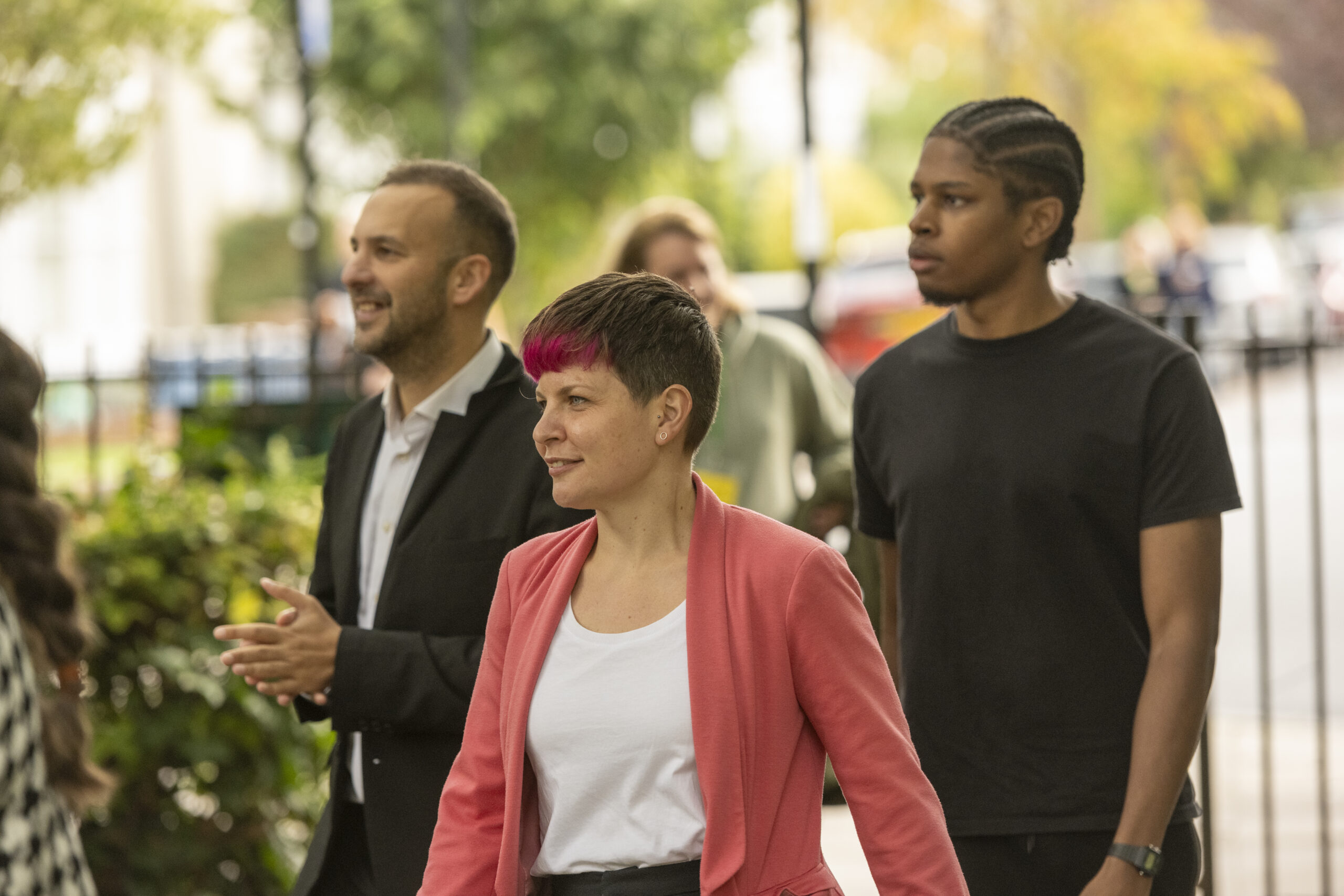
Garbett turned up 10 minutes early to meet me at Café Oto, a trendy Dalston alternative music venue. A fast-walking, fast-talking woman with short black hair tipped pink, Garbett looks at you with the focused stare of someone with no time to waste. She declines my offer of tea; she wants to get talking. “I don’t think Zoë has ever told me to do anything directly,” Alex Armitage, a friend of Garbett’s and a Green councillor in Shetland, told me, “but she’s just got me to do things.” Having spent some time with her, I understand what he means; her gaze alone is compelling.
Garbett is one of four children raised by a couple of teachers in Somerset. She attended her first protest in utero, as her pregnant mother – a mostly inactive member of the Green party – walked the perimeter of Hinkley nuclear power station to protest its expansion. As a kid in the early 90s, Garbett was brought on marches against education cuts, a prelude to her time executing those same cuts in the health service (“One of the toughest things I’ve had to do,” she told me). Garbett doesn’t think of her family as particularly political, however – she’s the only person to have stood for elected office – more as a group of people with a strong commitment to public service, one she sharpened in the Scouts.
It wasn’t long after graduating before Garbett found herself working in the public sector, a 20-something NHS commissioner in the London borough of Barnet. While working there in 2014, Garbett moved to Hackney, becoming involved in the local Green party. At first, she kept her political activism a secret, not wanting it to get back to the Tory councillors she worked with in Barnet. The ex-scout in her prioritised teamwork above all else.
This has served Garbett well in opposition. As a Hackney councillor, Garbett has frequently shocked her Labour colleagues – accustomed to a party riven with bitter factionalism – by endorsing their motions. In 2022, Labour proposed a motion on addressing the cost of living crisis; Garbett and another Green councillor proposed amendments to it, which were dismissed, then voted for the unamended motion anyway.
In 2023, Garbett approached Labour to co-propose a pro-trans motion. In May last year, Labour changed Hackney’s constitution to limit opposition parties’ ability to raise motions at council meetings. This threatened to frustrate a Green motion opposing Labour’s two-child benefit cap. So the party persuaded the Conservatives – who in Hackney are largely Stamford Hill Charedi (strictly orthodox) Jews, with large families and a greater reliance on state support – to propose the motion instead, despite their own national party introducing the cap in 2017. “I think we’ve been sort of trained into thinking that politicians wear ties and carry briefcases and stab each other in the back and don’t listen to people,” said Alastair Binnie-Lubbock, the Green councillor with whom Garbett was elected in 2022. “And I think people are sick of that.”
For its May election slate, the Greens have teamed up with an independent collective that includes several ex-Labour councillors; all are endorsing Garbett for mayor. In Hackney, Labour is realising that the Greens “are not just doing oppositional politics”, said Binnie-Lubbock. “Zoë’s been a leader on doing that, on saying, Actually, no, we can do politics differently on a local level, and we need to do politics differently on a national level, because it’s just not serving people.” For Garbett, that potentially means abolishing the directly-elected mayoral role entirely, which she believes overrides local democracy (she instead wants councillors of the majority party to appoint a leader, as most councils do). She’s also pledged to make her mayoral diary public.
Garbett’s desire to devolve power is evident in her mayoral campaign. Breaking with electoral convention, she has chosen to run alongside 20-year-old Dylan Law, a Green councillor candidate in Hackney Downs. If elected, Garbett has pledged to make Law her deputy (deputy mayor is a cabinet position the mayor appoints). Dylan’s age belies his credentials for the role – he’s spent years in Hackney’s youth parliament – but it’s clear Garbett is making a statement by having a young Black man be her running mate.
What is that statement? It’s recognising the limits of her own experience, she told me: “[Dylan] knows how the systems work and how they fail” first-hand, she said, “because of [his] experiences going through academies; his family living in housing associations and council homes; and just his experience of moving through the world. When we were thinking about this campaign last year, we were just like, how can we bring our experiences together?”
Law and Garbett knocking their heads together has predictably produced a campaign largely focused on a single issue: housing. Though not a typical Green talking point, housing is arguably the alpha and omega of Hackney’s problems. One of the first and fastest boroughs in London’s gentrification arms race, Hackney’s spiralling housing costs have seen swathes of its most marginalised residents – including its historic African Caribbean and Charedi communities – priced out of the borough. In recent years, the council has played host to one of the biggest housing “regeneration” projects in Europe, a 20-year plan to let loose developers on Woodberry Down Estate near Manor House, replacing 2,000 social homes with 5,500 mostly unaffordable ones.
Last year, the housing ombudsman investigated Hackney council, finding poor practice in the vast majority (79%) of complaint cases; in one case, an elderly resident was left without heating and hot water for seven weeks. When I asked Garbett the single issue that comes up most on the doorstep, her response was immediate. The Hackney Greens’ manifesto, due to be launched this Saturday, reflects that. It will promise to pressure the council to buy back council homes; improve council house repairs; and bring disused council spaces into community use. Do you think you’d be able to live in Hackney in the next five years, the Greens asked residents in a recent survey. The majority said no. “Make Hackney a place people can afford to stay,” the Hackney Greens’ manifesto will demand.
It would be a mistake to think that the Greens’ election platform has been focus-grouped out of thin air, however. Both as a councillor and assemblyperson, Garbett has pushed Hackney and the Greater London Authority to make more space for Londoners, whether as renters, workers or business-owners. A few hours after we meet, Garbett heads to Ridley Road market, the historic street market that’s been running since the 1880s, often described as the African Caribbean soul of Dalston. Garbett and her fellow Dalston ward candidate, Rachel Nkiessu-Guifo, have been supporting a group of traders in Ridley Road’s dilapidated indoor market to resist eviction by their offshore landlord.
When Garbett claims to want to help those being pushed out of Dalston stay put, locals believe her. “She’s not just a politician, she’s an activist,” said Amanda Bentham, part of the Hackney Independent Socialist Collective that’s standing alongside the Greens. “She was out yesterday with the Ridley Road market traders fighting evictions. She’s been on picket lines.” For example, when the police held an immigration raid on delivery riders in May 2022, as part of a concerted attempt between the council and police to push riders out of gathering in the centre of Dalston, and locals gathered to stop them, Garbett was right there in the fray.
I asked Garbett why, in 2014, she chose the Greens over (soon-to-be Corbyn’s) Labour. Wasn’t that the more natural choice for someone like her, who wanted to actually make change, rather than shout from the sidelines? She said she was struck by the Green party’s marriage of human and planetary wellbeing. For her, the Greens have always had social inequality in their core – “I always say that I deeply love Caroline Lucas as much as I love Zack,” she told me – it’s just that only recently have they found a way of articulating that, at both a national and a local level. “I think [the Greens] have really shown our deeper values around social justice, racial justice and economic justice. It’s just a sea change: people really know who we are and what we’re about.”
Like Polanski, however, Garbett is a little coy on terminology. When I ask her if she’s a socialist, she stumbles: “Yes, I’ve called myself a socialist, but I don’t love labels in general. Politics gets a bit hooked up on labels. But I definitely subscribe to socialist values.” Judging Garbett by her actions, rather than her words, it’s hard to conclude she’s anything but a socialist (or, for that matter, a police abolitionist). Garbett’s prevarication reflects what seems to be received wisdom in the Greens that the S-word is divisive (YouGov polling from 2024 suggests 38% view socialism positively).
Garbett’s mission to “get stuff done” may soon collide with reality. If elected mayor, Garbett will oversee a council with a budget of almost £2bn, debt of £153m, and cuts of £33.8m. What can actually be achieved with these kinds of constraints? At a minimum, says Garbett, it’s about ensuring that the council does the things it already has the power to do, such as enforce housing regulations and landlord licensing. Then it’s about empowering the council to be a “loud voice”: one of Garbett’s plans is to increase the size of Hackney’s planning team “so they can really stand up to developers”, though it’s hard to imagine a bigger planning team single-handedly rectifying the power imbalance created by decades of austerity. A Green-led Hackney council could – just as the party did in Brighton, and just as Garbett did in Barnet – find itself the executors of austerity. When Garbett talks about handling these constraints – about advocating for more money from central government – it’s clear she’s thinking beyond a single electoral cycle.
In a first-past-the-post electoral system, growing a small party means being in it for the long haul. It took the Greens over a decade of graft in Brighton before it could field Caroline Lucas as an MP. “You need to have exceptionally hardworking, exceptionally competent people who are exceptionally persistent in being about to chip away at the Labour majority,” Armitage told me. “In those days [2022], you could only become a Green Party councillor if your work ethic was completely off the scale. And Zoë is somebody like that.” Two council, one assembly and two mayoral runs in, Garbett is nothing if not tenacious. Once reluctant to even put herself forward as a councillor, she’s now quite aware of her own power.
Will she stand as an MP in 2029 if she’s unsuccessful in May? “I’ll be where I can make the most difference, and where people want me to be.” That’s not a no.
ENDS
Rivkah Brown is a Novara Media commissioning editor and reporter.