‘Evil’ Palantir Should Be Nowhere Near the NHS, Staff Say
Palantir is an “evil” company whose involvement in the NHS is damaging patient trust in the service, senior health workers have told Novara Media.
US spytech firm Palantir – which has provided military technology to Israel during its ongoing genocide in Gaza and custom surveillance tools to ICE in the US – currently holds a major patient data contract with NHS England.
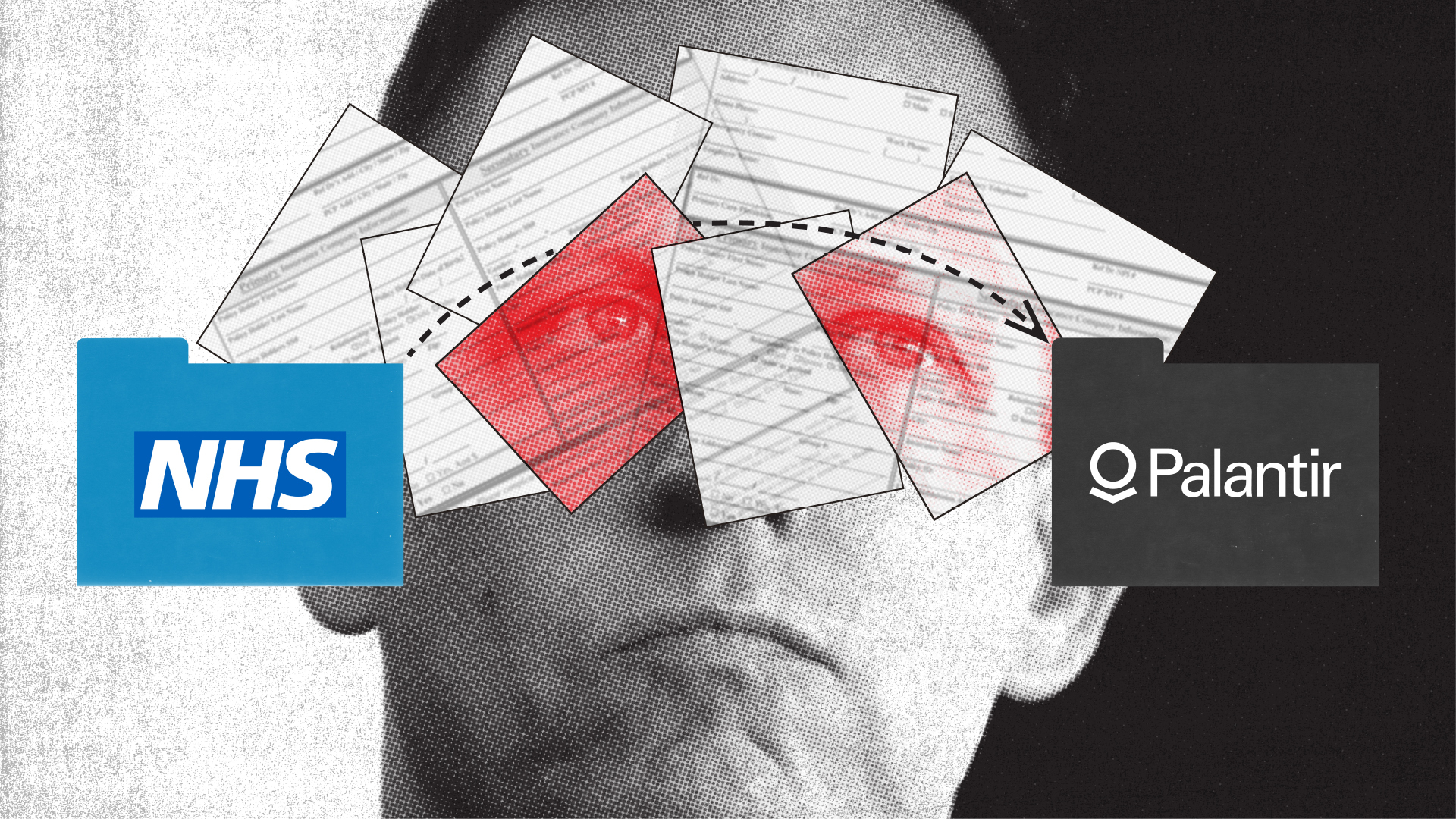
Palantir was contracted in 2023 to build and operate the federated data platform (FDP), which aims to pull together sensitive patient information from different sources into a single database.
Palantir’s products are commonly used by states in warfare, policing and mass surveillance, and the firm’s chair and co-founder Peter Thiel has previously stated that the NHS “makes people sick” and that British people’s affection for their health service is akin to “Stockholm Syndrome”.
NHS staff – both clinical and non-clinical – are increasingly raising concerns about such a company’s involvement with Britain’s health service and its access to sensitive patient data.
NHS consultant Anna* told Novara Media: “I don’t think Palantir should have anything to do with the health service. I think the company is evil.”
The cancer specialist said Palantir’s involvement is harming patient trust in the NHS, and she’s experienced patients “completely unprompted” asking her not to document something because they “didn’t want that information to be visible to a foreign company that isn’t based in the UK”.
“We’re told it’s all anonymised, and the data cannot be accessed,” Anna said. But she raised doubts about the security of the data.
“When you open [the FDP’s cancer tool],” Anna said, “it looks like a massive spreadsheet, basically, and there’s hundreds of patients’ details there. The rows are automatically populated with patients – people who somebody has identified need to be on a pathway for cancer – and it’ll pull demographics like their date of birth, their age, the NHS number when the referral came in.”
Last week, the FT revealed that NHS England has granted staff from external companies including Palantir “unlimited access” to identifiable patient data while working on an area of the FDP that’s described as a national-level “safe haven for data”.
Remi*, a senior NHS England employee working in vaccinations and screening who exclusively uses FDP products in their job, told Novara Media that patients’ vaccination data is meant to be anonymised. However, Remi said, the data is actually “pseudonymised” and it’s not difficult to see how patients could be identified by anyone with local trust knowledge.
Remi said vaccinations data should be “completely anonymous and non-identifiable” to anybody in their position, as a staffer who compiles vaccinations numbers for trusts but does not deal with patients directly. But “it’s not”, Remi said, explaining that they go to the trouble of filtering out some demographic indicators: “Part of my day-to-day is actually going a bit further to omit some results, in terms of trying to adhere to information governance rules – but that shouldn’t be something I have to do.”
Doctors’ union the BMA told Novara Media that it is “deeply concerned” by reports of NHS England granting Palantir access to patient data, which would realise medical professionals’ “worst fears about scope creep and the erosion of patient trust”. The BMA said: “This level of access by non-NHS employees threatens the very cornerstone of the doctor-patient relationship and risks deterring people from seeking vital care if they fear their data is in unsafe hands.”
An NHS England spokesperson said “strict policies” are in place for managing access to patient data and “regular audits” are carried out to ensure compliance. They added: “Anyone external requiring access must have government security clearance and be approved by a member of NHS England staff at director level or above.”
Even before the news that external contractors would be granted “unlimited access” to identifiable patient data broke, NHS England said access to patient data in the FDP “must have an explicit aim to benefit patients and/or the NHS in England”, which didn’t necessarily preclude Palantir staff or other government departments from being granted access. And according to healthcare workers’ charity Medact, NHS provider trusts were receiving requests from Palantir to access stored data on a local level that identifies patients multiple times in a working week.
Data management and privacy concerns around Palantir’s software processing and analysing confidential patient information have repeatedly been raised by patients’ rights organisations, human rights groups and health workers’ unions.
Locked in.
Originally valued at £330m, the full cost of Palantir’s FDP to the NHS is now reportedly set to exceed £1bn over its first seven years. While the cost is high, there’s a danger that the NHS could become trapped.
Remi warned that there’s a risk of the NHS becoming dependent on Palantir as a monopoly supplier – something known as ‘vendor lock-in’. “I think it’s by design and I actually find it sinister,” they said.
Remi is not sold on Palantir’s product from a technical point of view, saying they do not find it intuitive. “If I had to give it a score out of ten, I’d give it a five,” they said. But another concern is what happens if the NHS stops using it.
While Remi is clear that they support the ending of Palantir’s involvement with the health service, they said: “All of the work we do is on the platform, it’s not on files I can export or save. It’s all external. If we lost the contract today, I don’t see how we wouldn’t absolutely lose the work. And I know this because with their initial version [the Covid database], all the work I had on there was gone.
“If their platform no longer exists, our reports and our dashboards would cease to function, because it’s all done using their product.”
Palantir got its foot in the door of the NHS with an initial pandemic deal – won with no competitive tendering process – to collect and process confidential patient information in a Covid-19 data store for a reported cost of just £1 for the first three months. Palantir UK chief Louis Mosley, grandson of British Union of Fascists founder Oswald Mosley, has described the firm’s strategy as “buying our way in” and “hoovering up” small businesses working with the NHS to “take down a lot of political resistance”.
Mosley said in March that if Reform won the next general election with a “clear public mandate” to allow NHS data to be used for immigration enforcement, then the company would execute the plan.
Palantir’s reputation and relationships have been aided by Global Counsel – the lobbying firm set up by disgraced former US ambassador and friend of Jeffrey Epstein, Peter Mandelson – and by intense lobbying efforts directed at ministers and NHS executives.
Some NHS staff have been warned off criticising the FDP – run on Palantir’s Foundry software (the civil equivalent of its military product, Gotham) publicly, and even threatened with the loss of their jobs.
Anna tried to raise ethical concerns about the FDP with the chair of a hospital committee, but said her questions have been “ignored” and “brushed off”. She was told “maybe you don’t want to do that”.
In theory, it’s currently up to individual NHS trusts to decide whether they use the platform, but local trusts and integrated care boards have been under pressure to adopt it, with NHS England spending £8.5m on a consultancy firm for promotion. Currently, 168 NHS trusts have signed up for the FDP, of which 123 are using the system. The NHS can choose not to extend the national contract with Palantir at its review in early 2027.
“Patient trust is the cornerstone of healthcare, and opening up sensitive health records to external contractors – especially those like Palantir – raises serious ethical and privacy questions,” a spokesperson for Health Workers for a Free Palestine told Novara Media. “Public confidence in the NHS will be severely undermined if the government continues to push this contract.”
However, a spokesperson for NHS England credited the FDP with benefits including “joining up care, speeding up cancer diagnosis and ensuring thousands of additional patients can be treated each month – while saving money for NHS teams and taxpayers”.
Enormous value.
Anna believes that the NHS is failing to understand the value of patient data and worries that Palantir understands it all too well.
“Anonymous or non-anonymous, it doesn’t matter,” she said. “You’ve still got data. You’ve got hundreds of thousands of patients, details of their health, conditions, treatments and pathways, and over time, that builds up to an enormous database. You can do a huge amount with that, and it really should not be available to or given away to any company that’s foreign – and definitely not to a company like Palantir.
“We don’t seem to value it, but I’m pretty sure they [Palantir] do. They know the value of this data.”
Palantir’s UK office has been approached for comment.
*names have been changed
Harriet Williamson is a commissioning editor and reporter for Novara Media.