What Do People Attending a Tommy Robinson March Really Believe?
For a start, they’re not all fans of him.
by Richard Hames
19 May 2026
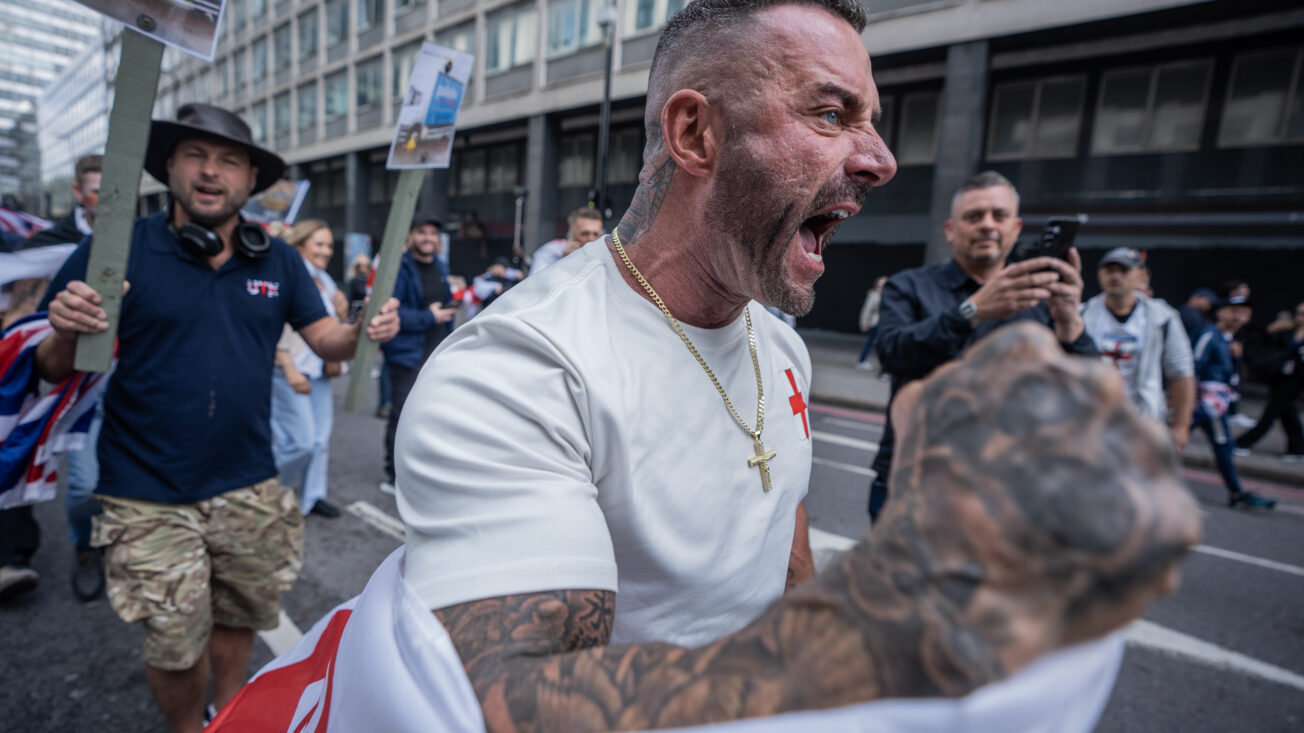
What do the 60,000-odd people at a Tommy Robinson march believe? Surely – at a minimum – they all like Tommy Robinson? I have news: no. He’s a “Zionist shill”, “a grifter”, I was told by two of his own attendees. One man confidently told us he wouldn’t have come on the march if it had been associated with Tommy Robinson (the march was organised and emceed by Robinson, real name Stephen Yaxley-Lennon).
Were they all, at least, united in their hatred of migrants? Not entirely, no – not least because some of them were migrants: Iranian monarchists, to be exact, here at Robinson’s request, they repeatedly told me. They held up banners of Robinson that depicted him and US president Donald Trump in shimmering light as saviours of the Iranian nation. Some called for the UK to immediately invade Iran. They were, at least, keen to underline that they were genuine migrants (as opposed to the fake ones you apparently get these days). Most of the British nationalists we spoke to looked on, bemused at their chanting.
Is everyone at a Tommy Robinson march at the very least a British nationalist? Perhaps – but there were also a surprisingly high number of Republic of Ireland flags and a fair few Israeli ones on display, as well as the aforementioned sea of Iranian monarchist flags. This is not exactly your traditional National Front march.
Of course, it’s not like there is nothing that holds these people together.
There is a core of commonly held ideas here, which we can list: Britain is good, but it has been lost in some way. Muslims, although not all bad, are disproportionately responsible for sexual violence in the UK (this is not true). Illegal migration must be stopped. Keir Starmer apparently doesn’t agree with this. He is a wanker.
These are commonplaces. Memes. Vague feelings made into words. They are not the ligaments of a serious movement. But even – or perhaps especially – simple ideas like these can be the starting point for a dizzying variety of worrying extremisms, as much as they can form the basis of a more normie kind of far-right politics that wishes for the status quo, but with a harder aesthetic.
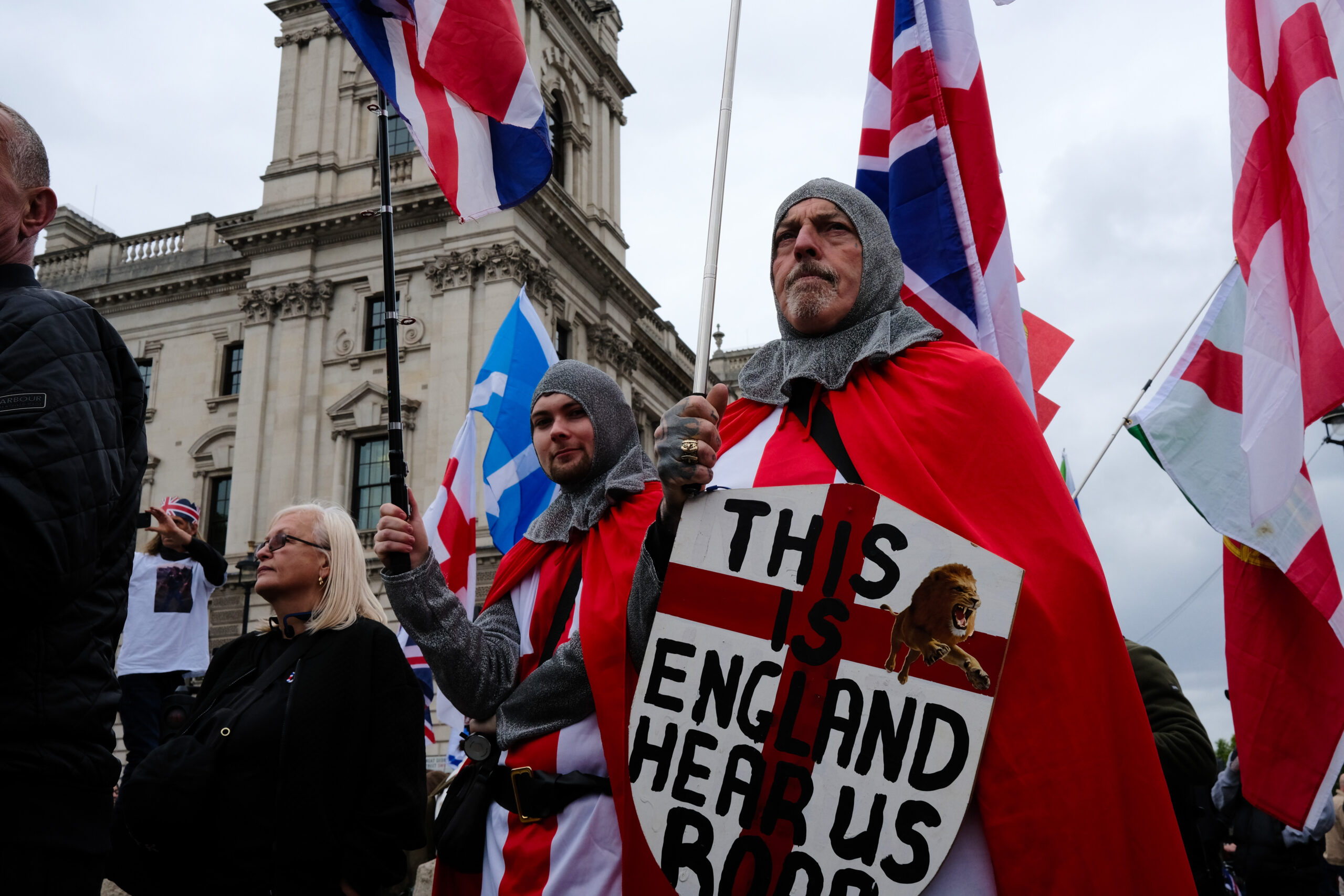
Here’s a selection of people I encountered at the march.
- A man with the famous Nazi phrase “Lügenpresse” (lying press) on a sign, who vociferously and disingenuously denied it was a Nazi phrase.
- Many people with “Christ is King” banners and clothing, a slogan increasingly beloved in Christian nationalist circles (itself a strange American import).
- Many who told me “millions must go”, a slogan calling for the forcible expulsion of millions of people from the UK.
- A woman who believed quite earnestly that Melania Trump was Princess Diana.
- A woman who thought that what the UK was currently going through was quite similar to King Alfred having to beat back the Danes.
- A woman wearing a keffiyeh and the current Iranian flag, who we initially thought might have intended to be on the Nakba Day march. But no. She was eagerly seeking out the far-right group Patriotic Alternative who she wanted to march with. She didn’t get there because the crowd, having spotted the keffiyeh, booed her away.
- A young woman wearing a #goyim_rising t-shirt who rushed to her to aid.
- The person I assume is her boyfriend, impossibly posh, hair quiffed up and wearing a ‘Rhodesia 1890-1980’ memorial tie, who tried to grab my microphone from me.
If that jumble doesn’t seem starkly contradictory enough, consider the would-be speakers whose entry to the UK was barred by the home secretary. Take Valentina Gomez, who said at the previous Unite the Kingdom march: “England, they took your guns, they took your swords, and they raped your women. You have nothing else to lose, but there’s still hope. You are still the majority. So you either fight for this nation or you let all of these rapist Muslims and corrupt politicians take over.”
Meanwhile, another banned speaker, Joey Mannarino, previously declared that “all rape accusations have become fake to me”. So which is it? Are all rape accusations fake? Or are Muslims somehow associated with rape?
This is the problem with generic political ideas: you can attach more or less anything else to them, even completely contradictory things.
The heterogeneity of the beliefs here is the result of a political strategy that Robinson has pursued for over a decade and a half: do broad strokes anti-Muslim agitation, gather people together under increasingly generic signs (“Unite the Kingdom”), possibly get himself arrested, claim some kind of victimhood, get money, repeat.
The question is: are the much simpler shared ideas enough to hold this movement together?
Well, for how long? Unite the Kingdom is not a political movement in any strong sense of the term. It is a proposition for a concept of a sketch of an idea of a movement. It is a family-friendly Big Day Out in the garb of a “cultural movement” (as Robinson called it from the stage). The idea of a march like this is to get the numbers up, to produce a sense of insurgency, to bundle that energy up into something like salable political influence, and then start planning for the next one.
Robinson is perhaps aware, now, of the limits of what this allows him to do and not do. As much as I could make him out on the flickering screen and echoey sound system, he was in the role of compère, not political leader. As it stands, Robinson has no serious proposition for meaningful or sustained power in the UK. He is, in the terminology adopted by early theorists of fascism, an “agitator”, whose purpose is to whip the crowd up into a frenzy. And the bigger the crowd, the more frenzy you can get out of them – and the more potential money you can make as you look to sell your influence.
The invitation extended to the Iranian monarchists is, one might assume, partially because they can make up the numbers in a moment when the energy on the far-right appears to be elsewhere, with the electoral side of the equation (Reform UK and increasingly Restore Britain).
But it might also be related to a transformation in the status of the man himself. Robinson is no longer just the main player in the British far-right’s street movement, he might also now be a bit player in a much larger political game that extends across the Middle East.
Following the previous (much larger) Unite the Kingdom march in September 2025, Robinson made trips to Israel, the Occupied Palestinian Territories (under Israeli supervision, of course), and the United Arab Emirates (UAE). To the extent that the people we spoke to at the march were aware of this, they were opposed. But mostly they simply weren’t aware. We might say that Robinson is now, in a sense, living a double life: both the lad from Luton, and as a relatively small influencer in a much bigger geopolitical game. How else to explain his sudden strident opinions on who exactly should run Yemen or Sudan after his UAE trip?
But why would the UAE – seriously powerful people with sovereign wealth funds to play with – be interested in Robinson? Perhaps because he has demonstrated his power to galvanise profoundly gullible people and get them out on the street in big numbers. That would mean the march isn’t about the march as such, but a proof-of-concept for a larger influence campaign.
There was, as far as I know, no repeat of the $UTK cryptocurrency promoted in advance of the 2025 Unite the Kingdom march, but the politics here have a similar feeling to a rug-pull nonetheless. People pour attention and energy into it – and then it all evaporates. Every attendee becomes an asset to be bundled up. The influencers who benefit from the march can sell the numbers of attendees as proof of some kind of cultural relevance.
The best way to understand the march is as a system of trades. The people who showed up get a day out and a feeling of insurgency. Robinson gets proof of relevance to capitalise on. The Iranian monarchists get a photo opportunity. Everyone gets something. Whether anyone gets what they actually came for – or whether or not this movement will become anything more substantial – is a different question.
But it was someone who wasn’t on the march who might have benefited the most: Rupert Lowe and Restore Britain. Their flags and branded clothes were most obvious among the crowds (we spotted a single, sad Reform UK flag). Perhaps he will be able to impose some kind of rough coherence on this ramshackle movement?
Lowe has advised his supporters that if they are called a racist the best way to reply is: “I don’t care.” Will he form a bridge between the street movement and the electoral wings of the British far-right? Will his brand of harsher immigration policy continue the extremism flywheel that we’ve seen operate in British politics for a decade and a half?
Given the clean sweep achieved by the Great Yarmouth First Party – Restore’s local affiliate – in the recent local elections, it is not inconceivable that he might form a serious spoiler to Reform UK at the next general election. Or even at the Makerfield byelection, where it will next be tested as a party.
Richard Hames is the host of Novara Media show Do Your Own Research.