BBC Question Time Assembled a Panel on AI and Forgot to Invite Any Critics
A masterclass in consent manufacturing.
by Ash Sarkar
29 May 2026
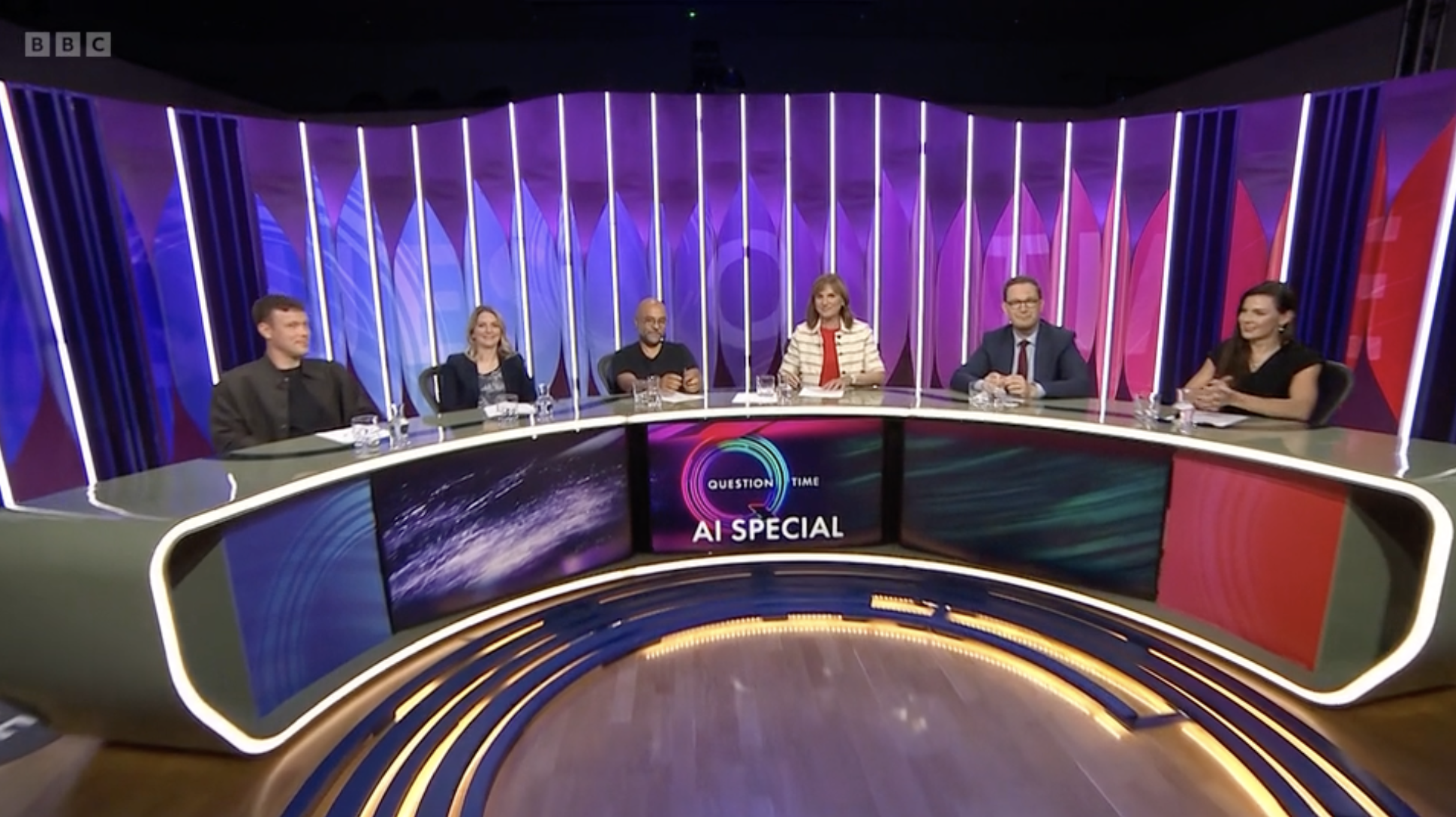
Incredible things are happening in the world of consent manufacturing. On Thursday night, BBC Question Time hosted an AI special, without a single anti-AI voice on the panel. All agreed that while AI presented challenges to the jobs market, there are opportunities to enhance human intelligence when used responsibly. Inspired, I asked ChatGPT to, err, unlock the full potential of my newsletter writing.
The few, the happy few, selected by the QT producers were Labour’s Darren Jones, Julia Lopez for the Conservatives, former Google exec Mo Gawdat, Laura Gilbert from the Larry Ellison-funded Tony Blair Institute, and Victor Riparbelli, the CEO of AI company Synthesia. While there was disagreement between panellists on e.g. whether AI posed an existential threat to the human race, or if falling in love with a chatbot was good or bad, certain assumptions went completely uninterrogated.
No one on the panel asked whether companies were laying off staff, or winding down hiring, before AI actually got good enough to like-for-like replace or improve on human labour. None of them raised the industry-wide, unpaid appropriation of copyrighted creative work to train large-language models. And, bizarrely, the impact of AI on education – written assignments becoming basically worthless exercises, with students getting to the end of even university degrees without penning a single essay by themselves – wasn’t deemed an important topic of conversation.
Instead, the QT crew demonstrated the astonishing potential of the technology by opening the show with an AI-panel which featured the oddly-smoothed features of Winston Churchill and Mahatma Gandhi. For all the frowny-faces and self-serious posturing about how AI is one of the most pressing issues of our time, the media conversation may as well have been dictated by an LLM. Offer some pros, some cons, race through hackneyed talking points and get to the end without ever really critically engaging the topic of discussion.
Welcome to humanity’s slop-era. In previous cycles of technological upheaval, we could accept immediate hardship and disruption in return for things getting better. Now, it seems like there is no better – only cheaper. Cory Doctorow, where are you when we need you?
I’m not sure if robots have a sense of dramatic irony. But the juxtaposition of the Question Time AI special with the government’s report on youth unemployment, released on the same day, itself told a story in miniature. Interviewees spoke of being rejected by dozens of jobs without ever speaking to a human being, the hiring process having been outsourced to an AI. Evidence points to entry-level jobs being particularly hard-hit by AI in more exposed parts of the labour market, thus disproportionately impacting younger workers. Meanwhile, retail and hospitality – two sectors already saturated with otherwise unemployed young workers – are struggling to contend with the increased cost of employment and the soaring price of commercial rents.
Questions hover over the actual capability of AI. Can a chatbot replace your therapist? Will AI tools be able to cure cancer, or speed up diagnoses? Is an LLM’s legal advice as good as a solicitor’s? Maybe this newsletter will age as poorly as spirited defences of horse-and-buggies did at the launch of the Model-T. But it’s worth considering whether the technology has already hit its enshittification phase, right when the political and capitalist classes are all busy restructuring our economies to the benefit of Silicon Valley billionaires. I suppose there’s some consolation there – if there’s one thing AIs can be certain of delivering, it’s NEETs.
Ash Sarkar is a contributing editor at Novara Media.


