The World Cup Team Palestinian Refugees Call Their Own
'We support Brazil because Brazil supports us.'
by Giovanna Vial
7 July 2026
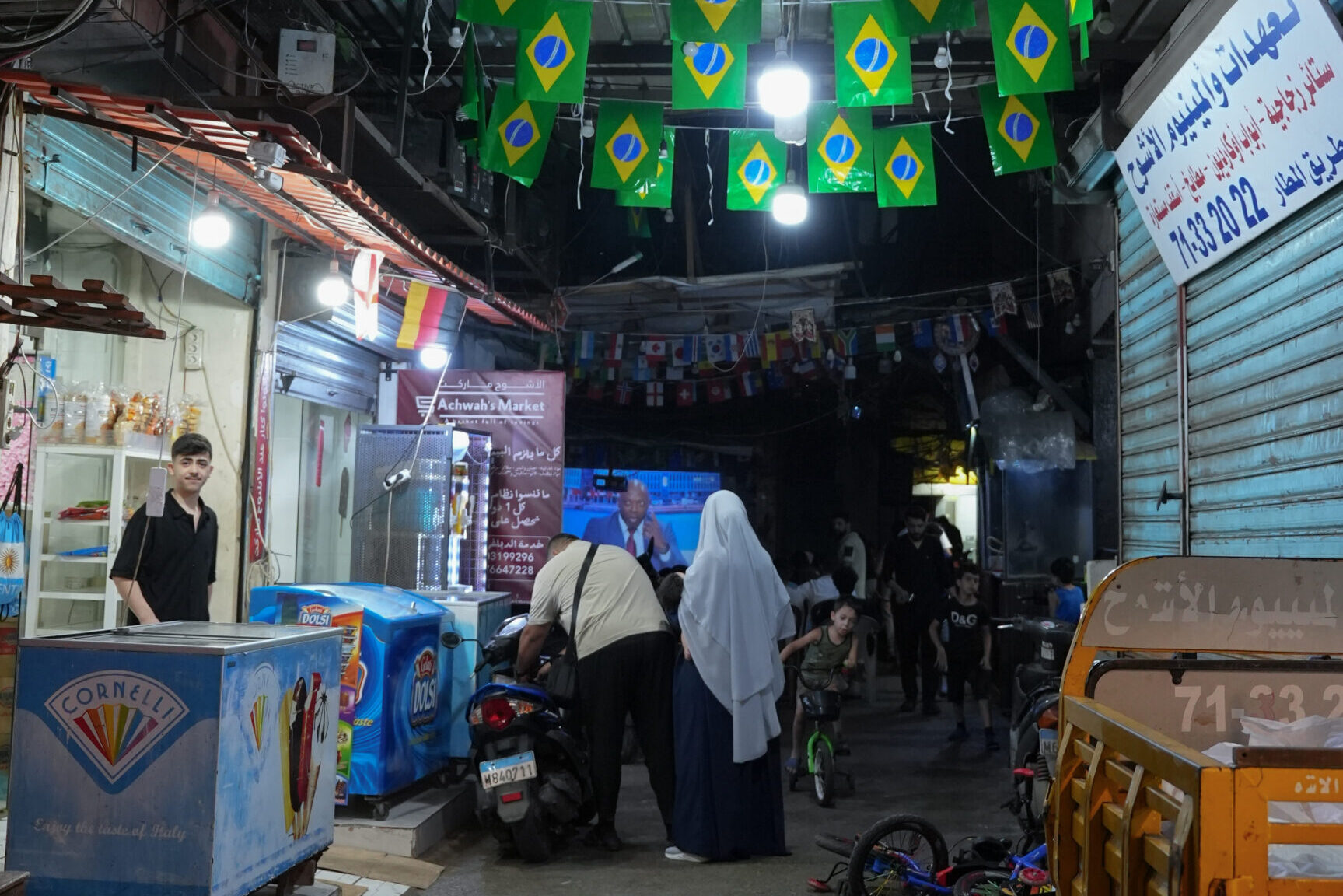
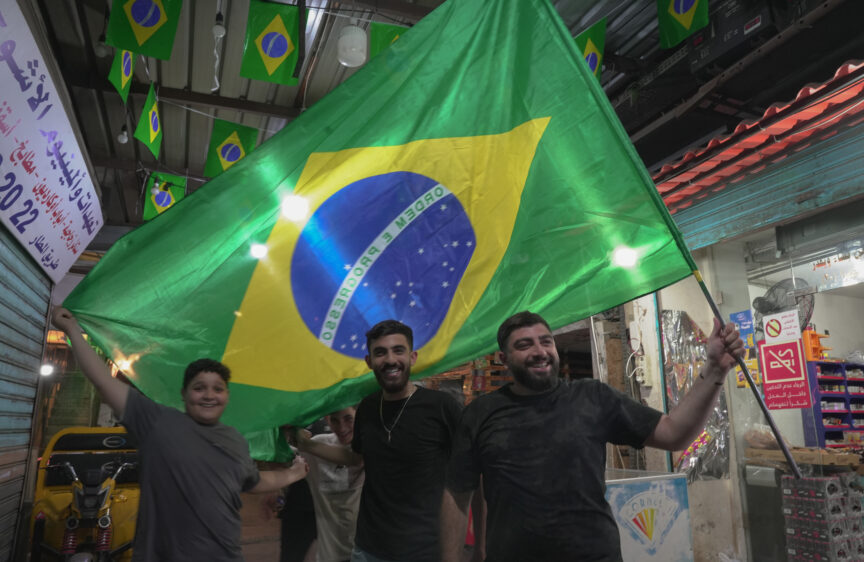
Motorcycles tear through the narrow alleyways of Beirut’s Burj al-Barajneh suburb, honking their horns. Children pedal bicycles in circles, screaming. 27-year-old filmmaker Mustafa Achwah leaps from a plastic chair and runs out of a crowded café waving an enormous Brazilian flag over his head. It’s the 50th minute of the second half of a World Cup match, Brazil has just scored, and for a few minutes, a Palestinian refugee camp in the Lebanese capital sounds like Rio de Janeiro on match night.
This was, of course, before Brazil’s nail-biting defeat to Norway on Sunday night. But the residents of Burj al-Barajneh never backed Brazil because the team had the best chance of winning.
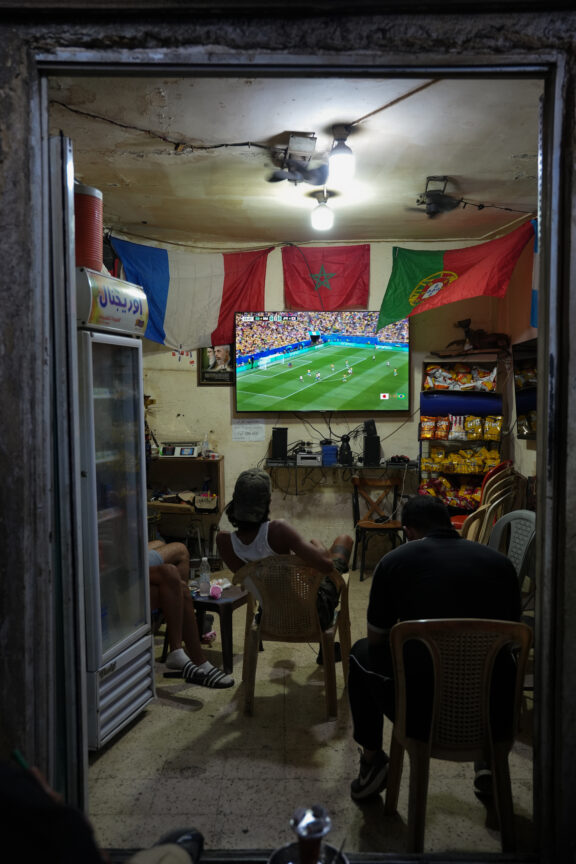
According to a United Nations count last year, 45% of Palestinian refugees live in Lebanon – some 230,000 people – and they’ve supported Brazil at every World Cup for decades. Far from being incidental, many say their loyalty is political.
Maha Mahmoud Mourah’s parents fled to Lebanon during the 1948 Nakba – the forced displacement of more than 750,000 Palestinians shortly after the creation of Israel. “We support Brazil because Brazil supports us,” the 57-year-old told Novara Media. “The government of Brazil likes Palestinian people. It openly condemns Israel for killing us.”
Brazil is one of the few major countries in the world that is not structurally aligned with the diplomatic architecture that produced and sustains Palestinian statelessness. Since October 2023, Brazilian president Luiz Inácio Lula da Silva has consistently called Israel’s conduct in Gaza a genocide, comparing it to the Holocaust, and recalling his ambassador from Tel Aviv.
While Lula has been in office for 12 of the last 23 years, far-right president Jair Bolsonaro moved the country significantly closer to Israel between 2019 and 2023 – not only geopolitically, but also as a central symbol for the country’s evangelical movement, where Christian Zionism has become deeply intertwined with conservative religious political identity. Support for Israel increasingly came to signify allegiance to a broader rightwing worldview, making criticism of the genocide in Gaza, for instance, politically costly.
Now, in 2026 – an election year in Brazil – Lula’s position on Palestine is a rare case of a major democratic government being willing to absorb a political cost for taking a clear stance on Israel’s genocidal policies. Bolsonaro’s son, Senator Flávio Bolsonaro – a leading figure on the Brazilian right and the main threat to Lula’s re-election in October – has made his unwavering support for Israel a strong theme of his political messaging. In a country where roughly one in four people identify as evangelical, that may prove consequential for the election’s result.
Inside camps like Burj al-Barajneh, people follow Brazilian politics with the same attention they give to anything that determines how the world is willing to see them. For the roughly 50,000 people who live there, the question of which states treat Palestinian lives as legible is not abstract.
The camps, which were established as temporary shelters after the Nakba, are still there seventy-eight years later – not despite Lebanon’s institutions, but partly because of them. Achwah, the filmmaker, is the third generation of his family to live in Burj al-Barajneh. But under Lebanese law, nationality passes only through the father, so Achwah – despite having a Lebanese mother and having been born on Lebanese soil – remains classed as a Palestinian refugee. As such, he cannot own property and is barred from practising medicine, law, engineering, and dozens of other professions reserved for citizens.
Lebanon leaves Achwah and hundreds of thousands of other Palestinian refugees in limbo as part of a demographic policy. Lebanon’s power-sharing system, inherited from the French mandate, allocates parliamentary seats and top state posts by religious sect, based on a national census last conducted in 1932 – when Christians were recorded as the majority. No count has been taken since. Publishing real numbers today would almost certainly show a Muslim, and specifically Sunni, majority, unsettling a political balance that keeps Maronite Christian elites, historically the community most aligned with Western policy and least willing to confront Israeli expansion, holding disproportionate power. Naturalising hundreds of thousands of mostly Sunni Palestinians would upend that arithmetic entirely. Keeping them stateless is not a side effect of the system – it is rather one of the conditions that lets the system survive.
For most Palestinians, then, what remains is a life lived inside the camps – unsanitary, dimly lit, densely built, where the only social assistance comes through UNRWA, the UN’s Palestinian refugee agency. In a Lebanon bombed by Israel almost daily, despite weeks of repeated ceasefire attempts, the World Cup – and Brazil’s team on the field, in particular – has also become a form of entertainment, relief, and an act of chosen belonging for Palestinians.
“Rooting for the team we choose to see ourselves in – Brazil, in our case – is one of the rare things about our identity that is actually ours to decide,” Achwah said. “I began to support the Brazilian team when I was just 10 years old – it is one of the strongest memories of my childhood in the camp.’”
Giovanna Vial is a multimedia journalist based between Brazil and Lebanon.