UK Universities Are Smashing Humanities and Arts Subjects to Pieces
And it’s not an accident.
by Juliet Jacques
12 October 2026
In June 2026, Exeter University announced plans to cut 150 jobs. These redundancies would barely touch management, or teaching and research in STEM (science, technology, engineering and mathematics) subjects. Unsurprisingly to those who have followed the assault on the UK’s universities over the last two decades, they would reduce support and especially academic staff, with 85% of the posts under threat being in HASS (humanities, arts and social sciences).
Nor would they be surprised to hear that, as an English lecturer told the New Statesman, the decision made no financial sense as the extra work for remaining staff would reduce their contribution to the Research Excellence Framework that determines their funding.
More than 40,000 people have signed a petition against the cuts, staff voted no confidence in their vice chancellor, and Exeter UCU have declared a trade dispute with the university.
The outcome remains to be seen, but the proposals fit into a long-term pattern of cuts to HASS departments at British universities, in a political and media climate hostile to the pursuit of such subjects, or public funding of art and culture.
The introduction of tuition fees for domestic students in 1998 (after Thatcher announced them for overseas students during her first year in office) and their trebling under the coalition government in 2010 were crucial in shifting the universities’ primary function from the creation of knowledge to the generation of capital, with the introduction of new layers of management to facilitate it.
This disincentivises students from less wealthy backgrounds from pursuing degrees without an obvious career path, with fears that they will never make enough money to clear their debts increasing since the financial crisis and austerity, and the imposition of interest on student loans. (For example, I owe more now than when I graduated in 2003 because my repayments cannot keep up with the interest, so it functions as an extra tax.)
The instilling of this depressing logic into the student body has been reinforced by the policy and rhetoric of every government since Thatcher’s – be it Conservative or Labour. Installed as prime minister to at least look as though he might mitigate some of the catastrophic inequality and injustice of the last 50 years, and to hopefully save his party as an electoral vehicle, Andy Burnham has taken a classically New Labour approach to the access issue by announcing changes in how loans are presented to students, rather than any cuts to tuition fees or renewed university funding.
Both are much needed: in 2024, nearly 4k HASS jobs were cut, with all but 110 in non-Russell Group universities. This reduced student choice, and now Russell Group institutions are making similar cuts. Burnham has had little to say about this. His emphasis has been on telling schools to adapt their curricula to ‘local business needs’, with prioritised funding for technical and vocational qualifications for 14 to 19-year-olds.
This isn’t a bad thing in itself: attending university at the height of the Blair government’s 50% in higher education plan, I met plenty of people who were passionate about their subject, and plenty who were there because they didn’t know what else to do – and who may have been better served by another option. Coming after the previous government’s repeated attacks on HASS, and the arts more broadly, however, it suggests a Labour administration that has little intention of dealing with the issues, and which has followed the last Conservative government’s lurch to the right as much as New Labour followed that of Thatcher and Major.
The white paper produced under Sir Keir Starmer’s premiership proposed no serious changes to a model dependent on higher fees from international students, increasingly put off the UK by its ever-more xenophobic attitudes, manifested in laws such as the one introduced by the Conservatives in 2024 and tightened by Labour, against Masters students bringing dependants. (For disclosure, I teach Masters students at the Royal College of Art, who are predominantly from overseas – we have far fewer students from EU countries since Brexit, and any significant political or economic changes in China would cause us and many other institutions big problems.)
A downturn in numbers of international students will further imperil university finances, and entrench their reliance on private funding, putting them even more at the service of corporate interests. The lack of noise, let alone any policy suggestions, from the Labour government about any of this – or about similar job losses in arts industries such as television – reinforces a state of hopelessness, with staff feeling that no one will stop the constant decline.
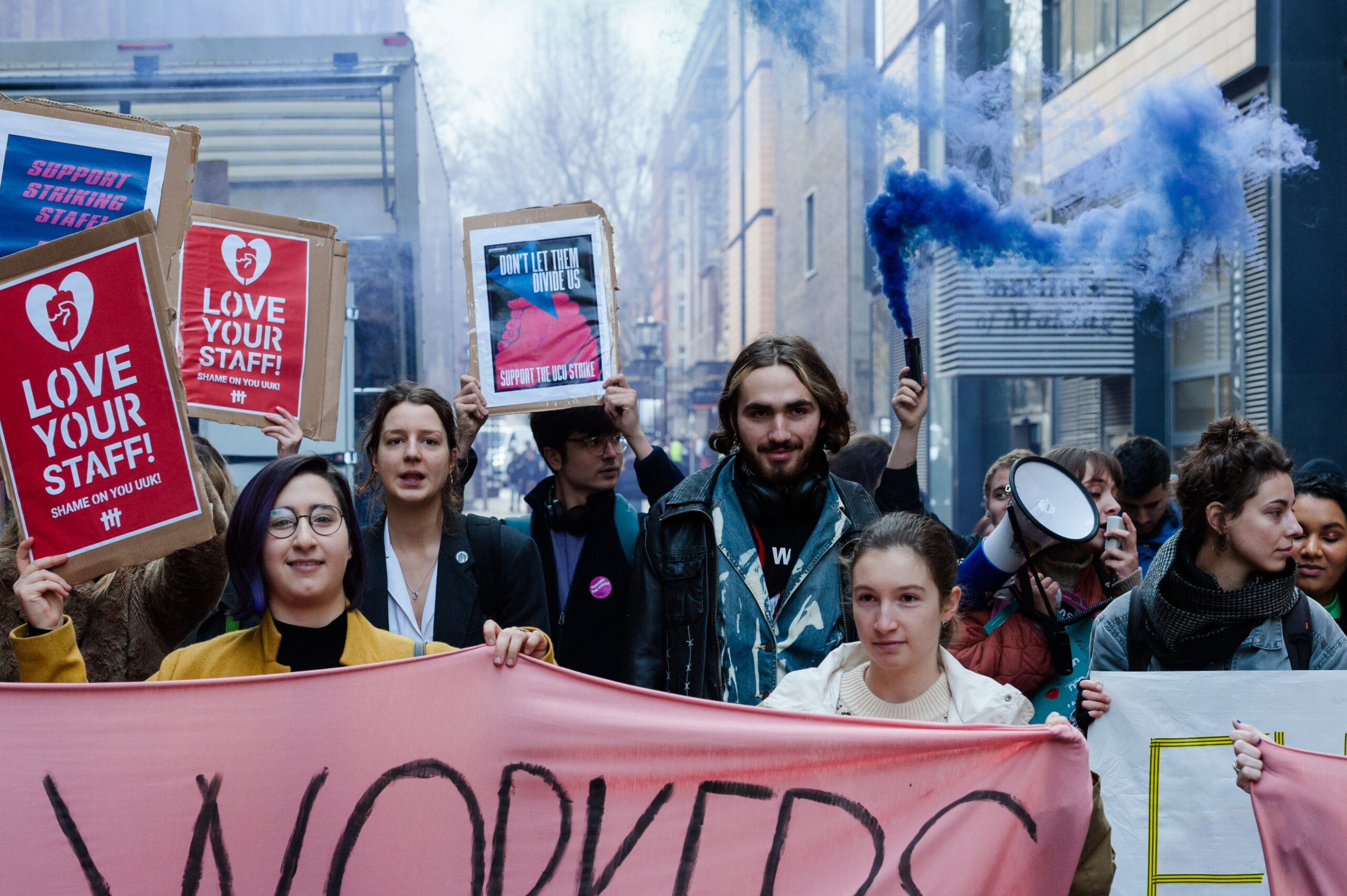
As might be expected, the University and College Union (UCU) are holding plenty of ballots, some of which have resulted, or will result, in strike action. The University of Dundee has cut 675 jobs through voluntary redundancies in the last two years, with plans announced to remove 154 more; the innovative Cooper Gallery, attached to the university, is also threatened with closure. Staff began a five-week strike on 21 September, backed by 79% of UCU voters.
Staff at Edinburgh went on strike over £140m cuts and 1,800 job losses, while university announced plans to scrap 90 degree programmes, with over half in languages, literatures and cultures. Essex, Sussex, Nottingham, Glasgow and others have also announced strike dates, and more universities will surely follow suit.
Shockingly, the University of Brighton announced the termination of all collective agreements with UCU and Unison by June 2027, coinciding with proposals to close its Falmer campus by 2030. The UCU branch has resolved to fight the plans, and industrial action looks a near-certainty.
None of this has happened by accident, given the relentless devaluation of the arts. During the New Labour period, it felt more possible to argue that the arts were good because they generated employment and income, and soft power for the United Kingdom – both through the universities themselves and the popularity of the music, films, art, comedy and other cultural works produced by people who had studied at them. That was before the Conservatives blew up the university sector out of class hatred. The whole concept of soft power has gone out of the window in recent years, rejected by an international far-right bloc which increasingly regards political diplomacy and cultural exchange as a waste of time and money.
Amidst the rise of the British far right – an inevitable product of the austerity programme that has smashed HASS courses, universities in general, the arts and wider society to pieces – it feels like time to go back to the cultural democracy arguments of the 20th century: that the arts and humanities are inherently good rather than just economically profitable, and they should be funded because they make life more enjoyable and interesting. (This is an argument Stewart Lee has made, compellingly, for years.)
The culture secretary, Lisa Nandy – of whom I, for one, have been critical for not fulfilling her remit – has written about how the Conservative government “virtually erased arts and culture from our classrooms and communities”, and how this needs to change, with the working class access to the arts that was hard won in the post-war period being restored.
It’s a very slow, small step in the right direction, and it needs to be connected to the huge challenge of rebuilding and refinancing HASS courses and reiterating the social uses of the arts – both things that Labour’s manifestos did in 2017 and 2019. Having rejected these manifestos under Starmer, Burnham is going to have to do the Corbynism without Corbyn that Starmer promised if there to be any hope to saving British universities – but if Nandy’s logic can be extended, then improved secondary arts education can put people on a long path to a life in the arts, and give the country a more diverse and vibrant culture.
Juliet Jacques is a writer, filmmaker, broadcaster and academic.