Is Your Party Over?
Back in the autumn, it felt like Your Party needed a mediator. Now, it feels like it needs a defibrillator.
On a wet, cold February evening, I went to visit the patient. In an exposed-brick Clapton wedding venue, miles from her Coventry constituency though on political home turf, Zarah Sultana was the guest of honour at a meeting of the Hackney proto-branch. As around 100 mostly retirees waited for the event to begin, I chatted to 47-year-old Junaid Eldem, who’d come straight from work still wearing his orange hi-vis.
Eldem works in a building supplies warehouse in Essex; he told me he’d hurt his neck that day craning it to see the pallets. Eldem never took an interest in politics – it took an interest in him. Eldem’s family fled Syria to Turkey during the Gulf war; he’d moved to the UK in 2000. He hadn’t been involved in a UK political party until recently, when he found out about Your Party at a meeting of the Socialist Workers’ party (SWP), the group ubiquitous at demonstrations though anathema to many on the left due to its factionalism and history of sexual assault. Eldem didn’t seem aware of the SWP’s reputation, instead happy that someone was starting conversations about Palestine in his area. Nor did he seem particularly aware of Your Party’s fractious beginnings. The Greens, meanwhile, weren’t on Eldem’s radar (“I don’t really know a lot about them”).
As I rudely checked my phone to see whether Keir Starmer had resigned, and which Your Party apparatchik was texting me to correct the opposing faction’s falsehoods, Eldem praised Jeremy Corbyn and Sultana in turn, seemingly oblivious to any feud. “We need change. We are desperate for something else,” Eldem said. “I hope [Your Party] is gonna generate some energy, some power, and make some changes for good.” Is anyone going to break it to him? I thought.
A disasterclass.
“It’s been a bumpy road,” was the identical euphemism used to me by two politicians involved in the party.
No sooner had Sultana tweeted the party into being than Jeremy Corbyn and Sultana’s factions were tearing chunks out of each other in the media. Locked out of the inner circle, Sultana unilaterally launched a membership portal, hoping to strong-arm Corbyn into dual leadership. Instead, she started a war. An exchange of legal threats followed, then a sheepish apology from Sultana. A truce was agreed, but the well was poisoned.
While the party exited the spotlight, several of its key players exited the party, both on Sultana’s side (Andrew Feinstein, Jamie Driscoll, Salma Yaqoob) and Corbyn’s (James Schneider, Justin Schlosberg, Joshua Virasami). The party staggered on, with power increasingly concentrated in the hands of Corbyn, his advisers and the Corbyn-aligned Independent Alliance (IA), who together comprise the party’s interim leadership (in case you were wondering, as many of its members seem to be).
As Sultana and Corbyn’s circles of confidantes dwindled, their spouses have become increasingly influential. Despite having no political background, Laura Alvarez has joined her husband’s meetings for years (it helps that MPs’ spouses get a parliamentary pass), often speaking on his behalf. More than one person who previously worked for Corbyn cited Alvarez’s outsize role as evidence of the “monarchical” and “royal family vibe” surrounding the ex-Labour leader. Meanwhile, Sultana’s husband Craig Lloyd, who previously worked for the Fire Brigades Union, reportedly told Sultana he wanted to make her “queen of the left” (he denies this). “If you ever become a political leader, don’t appoint your partner as your political adviser. That’s the problem both Jeremy and Zarah have,” someone close to both politicians told me.
Members’ last-ditch attempt to seize the reins from the dysfunctional leadership was ignored. A hastily-organised founding conference in November provided ample opportunity to unsquash the beef, with accusations of anti-democratic wrangling, financial skulduggery and childish media stunts. Karie Murphy – Corbyn’s closest adviser and former chief of staff – led a purge of hard-left members oddly reminiscent of Morgan McSweeney’s witch hunt of Labour leftists, including them. It was Labour all over again, someone close to the leadership observed to me – only this time Corbyn’s faction controlled not only the leadership, but the party machine. Then it was Christmas, and the trench warfare was suspended.
Just seven months in, those still involved in the party sound exhausted. Its co-founders pose stiffly at events, while jockeying for position. Meanwhile, Your Party members watch on hungrily as Zack Polanski – a former Corbyn-sceptic Lib Dem who now nicks Corbyn’s lines – eats their lunch. A recent YouGov poll showed Green support among 18-24-year-olds – Corbyn’s 2017 “youthquake” – is now at 37%. Your Party isn’t statistically significant enough for the pollster even to offer the party as an option.
Five months ago, almost one in five Britons said they’d be open to voting for a new Corbyn-led party. Now, the country seems virtually unaware that such a party exists. Two leftwing Labour MPs – the kind you’d think might defect to Your Party one day – both told me they had stopped paying attention. Nor might there be anything to pay attention to for long: one politician who was heavily involved in the project for several months, and still publicly backs the party, told me privately they fear the whole house of cards is about to collapse.
There is another way of telling this story. It’s that a man who lost a four-year battle royal with the British establishment – and is chronically indecisive, conflict-avoidant and, though surrounded by deeply ambitious people, hates to lead – was loath to put himself through the wringer again. Having set up a forgettable social justice campaign, he was eventually dragged from his allotment to launch a party – not a federation of small parties, not a loose association of independents, but an actual, national party.
As the party gradually assembled an impressive melange of trade union leaders, local mayors and seasoned organisers, the genocide in Gaza and a Labour encore of Tory austerity have offered an opportunity for the chameleonic Greens to turn red. Yet they persisted, knowing that many people want a party that’s socialist not only when it’s fashionable to be. While the egos at the top of the party have been swashbuckling, thousands of members in over 180 proto-branches have been organising, undeterred by the playground politics of the rival cliques.
Your Party now claims over 55,000 members (a figure Novara Media couldn’t verify, since the party wouldn’t provide evidence of it). If that figure is accurate, it would make Your Party the largest socialist party in Britain since the Communists in 1942. Why can’t Your Party hack its way to growth like Nigel Farage and Reform? Farage has been at it for decades, chipping away at the national consensus on Brexit and immigration until his outlandish ideas became, to many, common sense. Your Party is trying to replicate Farage’s success for the left, but without the tailwind of billionaire-owned media. Yet given how many unforced errors the party has made in less than a year, can it?
A matter of life and death.
Whether or not you think there’s hope for Your Party, said Shanice McBean – who, as a party member and co-host of the podcast Life of the Party, has a vested interest in the question – “depends on what you conceive Your Party as being for.” “I think the general consensus amongst members is that it would be an electoral project to take on Labour. So looking at it that way, you can argue that they’ve missed the boat entirely.”
Your Party has announced it won’t stand a candidate in the Gorton and Denton byelection. Insiders doubt Your Party will make much of a dent on May’s local elections, either. McBean isn’t even sure the party will have much to say by the general election in 2029, beyond being a minority partner in progressive coalitions. She doesn’t seem worried: “I personally don’t think elections are the be-all and end-all of politics.”
At the heart of Your Party are two radically different notions of what the party is for, broadly represented by its two co-founders.
On the one hand, there is the Corbyn set, made up largely of trade union and Labour party types. Their thinking remains heavily shaped by Labourism despite its treatment of them (recall that Corbyn didn’t quit the party until he was expelled from it in May 2024, enduring years of humiliating suspension). The desire of the Corbyn faction – in particular Murphy – is for a disciplined party with a strong, name-brand leader dead-set on winning elections. Corbyn, they believe, is the only person who can unite the nation around a socialist party.
Those clustered around Sultana, on the other hand, drawn largely from left intelligentsia and grassroots organising, largely agree that Corbyn is a sine qua non of the project. However, they fear Corbyn-worship, which they see as being at odds with Your Party’s stated aim of “doing politics differently”.
The Sultanites and other grassroots groupings believe that a party run along the Corbyn faction’s lines – hierarchical, tightly controlled, election-oriented – risks becoming Labour 2.0, complete with the same stifling bureaucracy and disciplinary instincts. They argue that some of these tendencies have already been evinced in the Corbyn faction’s shopping of Sultana to the Information Commissioner’s Office; its withholding of money and data from proto-branches (Corbyn’s faction would argue her faction withheld the money for conference, which they deny); and its expulsion of party activists over their membership of other leftwing groups. Before winning elections, the Sultana faction’s priority is a democratic party structure, one that empowers members and inoculates against the kind of takeover McSweeney staged of Labour. For the Sultana camp (to which McBean, as a member of another since-shuttered splinter group, Organising for Popular Power, sits slightly adjacent), Your Party is taking its time, laying the foundations of a mass socialist party of the kind Britain hasn’t seen for over half a century. Many believe that, with Reform on course for a 311-seat near-majority, time isn’t a luxury Your Party can afford.
“We really don’t have time for the Marxists, Leninists, Trotskyists, Bolsheviks, Mensheviks, Sparticists, Revolutionary Communists or whatever sect in Your Party to get their shit together in order to take on the challenges we face – they never might overcome their miniscule differences or the battle of the £1 newspapers,” Mish Rahman, a former Labour politician-turned-Your-Party-insider who defected to the Greens last month, told Novara Media. Rahman said he doubts the differences between the two camps are as substantive as they’re made out: “[Sultana and Corbyn] are not far off each other [politically], it’s just a proxy war for control.”
That war could be reaching its finale. Voting for Your Party’s leadership collective or central executive committee (CEC) – which opens today and closes on 23 February, with results expected three days later – will determine which of Sultana or Corbyn’s factions runs the party.
Compared to the spicy showdown shaping up in Gorton and Denton – which, incidentally, will take place the same day as the CEC results are announced – Your Party’s internal elections seem frumpy and procedural. Yet they may be more consequential in the long term. “Where we’re at now is essentially a political contest internally to decide the fundamental question about what kind of party it is,” one Corbyn-aligned party insider told Novara Media. “In my view, this will determine whether it lives or dies.”
Twenty-four leaders.
The CEC’s existence is one of the few wins of the Sultana camp. After Sultana was locked out of the “sexist boys’ club” of the Independent Alliance – they would say, after she lost influence following a miscalculated power-grab – Sultana presented herself as the voice of the party’s grassroots. She championed “maximum member democracy”, condemned the party’s “unelected interim leadership” she had once hoped to join, and refused to enter the conference hall in protest at the witch hunt of dual members. During the conference, members narrowly voted for the collective leadership model Sultana and others had pushed for.
Once elected later this month, the CEC will comprise 20 rank-and-file members – including just one each from Wales and Scotland – and four public office holders, such as MPs and local councillors. Six officers, including a chair and spokesperson, will oversee the day-to-day running of the party; none can be public office holders. CEC elections will run every two years. The party’s constitution – currently a Google Doc – gives little more detail. Yet if members voted for collective leadership in the hope it might defuse the conflict between its co-founders, they were sorely mistaken. It has ended up distilling it.
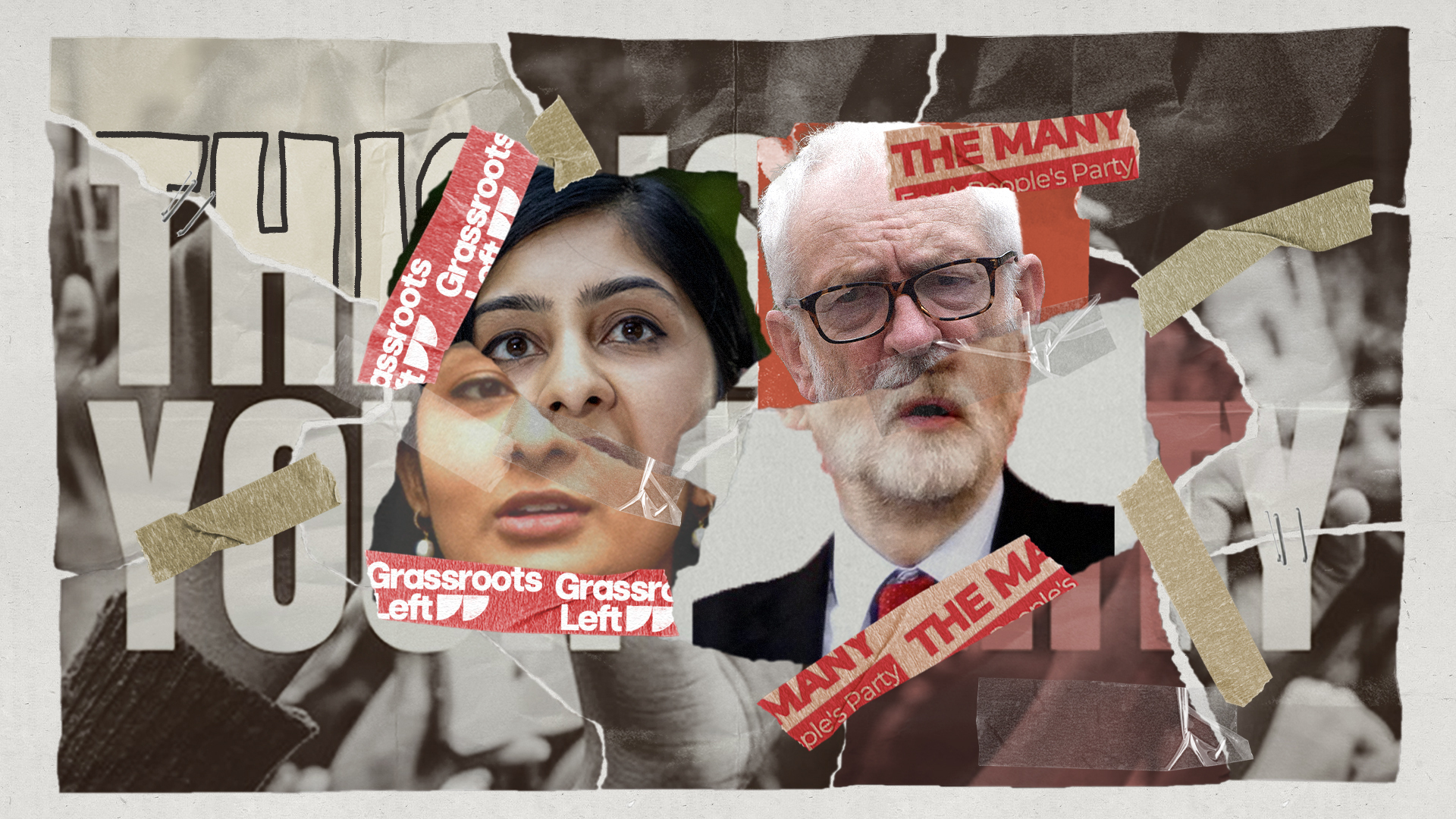
Sultana and Corbyn are running on rival slates for the CEC, Grassroots Left and The Many (though the former has endorsed Corbyn, ostensibly to avoid the appearance of factionalism). Grassroots Left is noticeably younger and more racially diverse; several of its candidates have been involved in protest movements and tenant organising. It insists bullishly on its differences from other leftwing parties – in a statement opposing Your Party’s decision not to stand in Gorton and Denton, Grassroots Left called the Greens a “pro-capitalist, pro-Nato party” – and often seems more inclined to provoke than to persuade. “We need to nationalise the entire economy,” Sultana told my colleague Steven Methven at the party’s founding conference (“Even boybands?” Owen Jones asked). For people like Rahman, it’s the narcissism of small differences. For Sultana and the Grassroots Left, making an unapologetically leftist pitch is essential, particularly during such a pivotal election.
Max Shanly is a former Corbynite organiser and longtime friend and major influence on Sultana; he is now standing alongside her on the Grassroots Left slate. “[The Many] is happy with reforming capitalism,” Shanly told me. “[We want] to go beyond capitalism entirely.” Shanly disagrees that we should nationalise the whole economy, though: “That’s a way of building a hotbed of reaction among small business owners”. Yet won’t calls to abolish the monarchy, another of Shanly’s ideas that Grassroots Left seems to have adopted, alienate just the same petty bourgeoisie? For Jenn Forbes, a CEC candidate for The Many, Shanly’s distinction between the two slates displays “the kind of sectarian mentality that is keeping Your Party down, more worried by internal point-scoring and the purity of our positions than the power we can build together. … It’s the winning politics of Mamdani versus the serial failure of so-called revolutionary sects.”
The Many has generally eschewed philosophical debate about what the party should be – its candidates have avoided proto-branch hustings – taking as read that members want a broadly leftist parliamentary vehicle led by Corbyn. Its candidates are older and overrepresented by local councillors and lifelong trade unionists, as well as pro-Palestine, socially conservative Muslims who followed Corbyn out of Labour. Three of its four office-holder candidates are men. McBean said she felt “disrespected” that The Many includes no Black candidates, particularly given its promise of a “multiracial coalition”, though Corbyn now seems to prefer “cross-community coalition” (The Many declined to comment on its lack of a Black candidate). While Grassroots Left has a long but thin policy platform focused unglamorously on party structures – student sections, independent financial audits, a “democracy commission” – The Many has stuck to bland pronouncements about the importance of unity and a smattering of policies suspiciously similar to those of Corbyn’s Labour.
More recently, both factions appear to have become aware of their reputations – The Many’s for authoritarianism, Grassroots Left’s for puritanism. Soon after Grassroots Left’s defiant statement on the Manchester by-election, Sultana released her own, distancing herself from the slate’s position and endorsing the Green candidate. “The left is strongest when it is united,” she wrote, surprising many (particularly those who suspected Sultana and her husband had been involved in drafting the original statement, which Lloyd laughed off to me). Meanwhile, in a recent op-ed for Novara Media, Corbyn reminded readers of his creation of Labour’s community organising unit and insisted he wanted a “democratic and member-led party”. His advisers, it seems, do not: “Their plan is to keep control of the party, a smaller party they can utilise, relive and settle the scores of 2015 to 2019,” said one former Corbyn ally. Meanwhile, his wife openly attacks rival factions on X/Twitter.
Noor Jahan Begum, a candidate on Corbyn’s slate and an independent councillor in the east London borough of Redbridge, echoed this democratic rhetoric, telling Novara Media that “Your Party should be rooted in communities”. Probe a little, and it’s clear that electoralism and party discipline remain The Many’s key tenets. “We need to be fighting Reform,” Begum told me, repeating this mantra four times in our conversation. “There has to be a focus on winning seats.” For Begum, that means giving community organisers “a level of autonomy, but on the other hand … maintain[ing] discipline, otherwise you can’t move forward.”
“The personalities haven’t changed,” one soft-left Labour MP observed to me. “They’ve just had their fingers burnt. There’s been no damascene conversion.”
For Richard Seymour, the Marxist thinker and member of Your Party, the CEC elections offer an unattractive choice. “I probably will vote for the Grassroots Left, but without a huge amount of enthusiasm,” he said. Seymour presents the CEC elections as a contest between a faction “overwhelmingly focused on party democracy, the empowerment of activists and so on, so is very inward-facing” and “another platform which essentially is more outward-facing, but is incredibly vague about the kind of agenda that it wants to pursue”, one whose “only real message to members … is we mustn’t turn inwards and fight one another. Well, guys, I mean, let’s be real. We’ve all seen your Twitter accounts – you have been fighting.”
“Part of the problem is that on the one hand, you’ve got those who don’t really know how to distinguish and differentiate themselves from the Greens as they currently are, and I don’t really think have a very sophisticated strategy at all,” said Seymour. “And on the other hand, you’ve got Sultana, who does get that you have to somehow draw some clear distinctions, but does so in a way that feels quite arbitrary. Everything that has been going on since summer, it reeks of distorted priorities and a distorted perception of what’s really at stake.”
Members’ endorsements suggest neither of the rival slates will have a supermajority on the CEC, instead roughly splitting it between them. Given the bad blood, it’s difficult to imagine how such a divided CEC will work together.
Anahita Zardoshti is a young British-Iranian and one of Grassroots Left’s two London CEC candidates (the other, Mel Mullings, is a young Black woman train driver and organiser in the RMT). Speaking to Novara Media, Zardoshti told me ominously that she can’t imagine what will happen to the party if The Many wins a majority on the CEC, suggesting she sees little grounds for cooperation, though she insists she won’t quit. “Sources close to Jeremy Corbyn” have been making veiled threats to walk if their side loses. Much like a sexual polycule, the unorthodox leadership model Your Party has chosen relies on maturity, trust, shared values and clear communication – all of which the party sorely lacks.
For his part, Rahman believes “collective leadership will not work”, adding that the utopian concept had been “missold” to members. “How will a serious political party be able to take to the public something without a single leader?”
To Green or not to Green.
Where could one possibly find a democratic party that doesn’t publicly air its dirty laundry? Zack Polanski raises a quiet hand. His party, known for its comparatively flat structures and collegiate culture, has attracted many who might otherwise have joined Your Party (or who briefly did). Yet there is – and will likely remain – many people for whom the party is insufficient. Even Rahman, now safely ensconced in the non-toxic Green party, agrees Your Party has its place. “There are seats the Greens would never win, that Your Party might.”
Niall Christie joined Your Party as soon as Sultana launched its first – swiftly yanked – membership portal, though he was already a party activist by then. He was involved in setting up proto-branches in his hometown of Glasgow, then in Edinburgh and Lothian, from August last year. The first Glasgow meeting had over 200 attendees. Another that Sultana attended drew over 300. Christie attended the founding conference and, despite the drama overhead, quite enjoyed it. After being a Green member for nine years, Your Party is a breath of fresh air.
Christie told me he had spent most of his time in the Scottish Greens – the sister party of the one Polanski leads, known for its slightly more conservative bent – trying to “keep the party honest”. He says that while “there are [Green party members] who would call themselves socialists”, such as Polanski, the party isn’t socialist at its core. “They’re a liberal, centre-left party who will, when push comes to shove, vote and act in the interests of maintaining their power with the political establishment,” he said. “They need a force to their left.” Though mostly consumed by infighting, the presence of a competitor leftwing party has, some argue, kept the Greens on its toes. “The direction of travel of Your Party is having a direct impact on the Greens,” Lewis said.
There is in Sultana’s camp a sense that while Polanski’s party may have picked up large numbers of so-called “slacktivists”, Your Party will attract people who can’t live on a diet of viral videos alone. Trade unionists, Palestine protesters, tenant organisers – people used to being out on the street every Saturday with a banner. Andrea Egan, the newly-elected leader of Britain’s largest trade union, has praised Your Party in several interviews. It’s hard to imagine her, or any union leader, mustering the same excitement about the Greens.
While the Green party recently breached 190,000 members, it may struggle to reconcile the variegated political traditions – from Green Tories through to revolutionary socialists – it’s absorbed under Polanski, given its political DNA is liberal environmentalism (one of its co-founders was a former Tory councillor). Polanski is on just a two-year term – without him, the party’s direction could drift back to centrist roots. By contrast, these early disputes over Your Party’s political identity could make the party easier to sustain once it gets going – or they could destroy it.
“The Greens have completely monopolised the media landscape, and really quite effectively positioned themselves as the alternative to the left of Labour,” said McBean. “What the Greens lack, though, is realignment on the kind of British and socialist left more generally. If you look at Your Party as the kind of historic alignment of socialist forces and the kind of trade union movement and British social movements, then … there is still hope and opportunity that Your Party can play that pivotal role.”
“Is Your Party going to dissipate?” asked Seymour. “I think it wouldn’t be a bad idea for the party to go under the radar for a little while. I don’t mean that it shouldn’t campaign vigorously on what it needs to campaign on. … I just mean, rather than trying to command the national attentional space on the left with what appear to be ill-conceived interventions, I think it would be better to start off on a more humble footing, prove ourselves with some useful work.” Ironically, this is one of the main reasons Corbyn was reluctant to form a party in the first place, because he felt that the work needed to begin by building a foundation at the bottom, not at the top.
Away from the drama playing in WhatsApp chats and Murdoch media, Your Party members have been doing some useful work. Despite being denied data and funding by the leadership, proto-branches have joined bus drivers, refuse workers, doctors and teachers on picket lines; launched local campaigns for better bus services and disability funding; and co-organised counter-demonstrations when the far right has come to town. Meanwhile the Green party, according to party member and chronicler Adam Ramsay, is on a journey to convert Polanski’s fans into activists (though with the party’s Gorton and Denton office as packed as a late-night kebab shop on my colleague Aaron Bastani’s recent visit, the Greens appears to be making headway on this front).
Much like McBean, Christie isn’t focused on Westminster. “Especially if you look north of the border, there’s been no big split opinion, just ordinary [Your Party] members trying to build a political party from scratch,” said Christie. “People are still dedicating their evenings to get a conference sorted, to write and draft a constitution, to build a movement.”
Whatever happens to it in the coming months, it’s undeniable that Your Party has energised certain segments of the left. The World Transformed festival, thought to be on its last legs following financial troubles and its disaffiliation from Labour conference, surged back into life this year. Leftwing journals and Substacks are brimming with think-pieces about the party, while even centrist outlets that sneered at Corbyn are now closely monitoring its developments (one imagines, with a degree of schadenfreude). New podcasts have emerged in the party’s wake (McBean insists hers isn’t exclusively about Your Party but rather the broader left political revival, though that seems a convenient claim now the party is floundering). People who’ve had nowhere to put their energy since the death of Corbyn’s Labour finally have a vessel. “Even if Your Party fails,” said Zaradoshti, “it’s activated a lot of people who were sleeping for a while. … We’ve not had a discussion on this scale on the British left for a very long time.” It also hasn’t had such bitter arguments.
At present, it’s hard not to see the project as a make-work scheme for laid-off Corbynites. The problem is that it is not only people who enjoy long branch meetings and semi-ironically call each other “comrade” whom Your Party needs to attract, even if its focus isn’t winning elections. To make any meaningful difference to British political life, whether on the streets or at the ballot box, Your Party needs to bring many more people like Eldem into the fold – people with a newfound, or only passing, interest in politics, but an urgent need for change. With Starmer on his way out and Polanski on his way up, the moment is ripe for change – but Your Party, for all its grandiose rhetoric, is consigning itself to parochial squabbles.
Members are still dutifully turning up to things – but for how much longer? Just 250 people attended each day of Your Party Scotland’s founding conference in Dundee at the weekend, scarcely more than a well-attended branch meeting. It’s clear that the infighting is having a major demobilising effect, while those responsible for it appear to be doubling down. The best hope the party seems to have is that the CEC election disempowers its co-founders, but even if it does, they can always leak to the Times, or complain to their millions of followers, or walk away. Leaders cannot single-handedly sustain the party, but they could easily wreck it.
Both factions love to cite Zohran Mamdani as evidence of what the other lacks. Mamdani was ecumenical, coalition-building, the Corbynites say. He was a thoroughbred socialist who came up through the Democratic Socialists of America (DSA) and refused to water down his politics to appease the establishment, the Sultanites clap back. Yet both studiously disregard the main thing Mamdani will be remembered for: being a “happy warrior”, an unfailingly positive candidate who spent minimal time attacking his opponents and maximal time setting out his stall. “The left in the UK can be a bit uptight, a bit wrapped up in being right,” said Seymour. Both Sultana and Corbyn have spent their entire political careers in opposition. Yet unless both can unmount their high horses and divert their energy from winning arguments to building power – together, as the CEC will inevitably demand – Your Party is doomed to disappoint the millions of people who, like Eldem, are “desperate” for it to succeed.
11/02/25: This article was amended to clarify that Shanice McBean was not a member of Zarah Sultana’s faction, but a faction called Organising for Popular Power.
Rivkah Brown is a Novara Media commissioning editor and reporter.