Spycops Could Be Authorised to Have Sex With Palestine Action Activists, Says Ex-Special Branch Chief
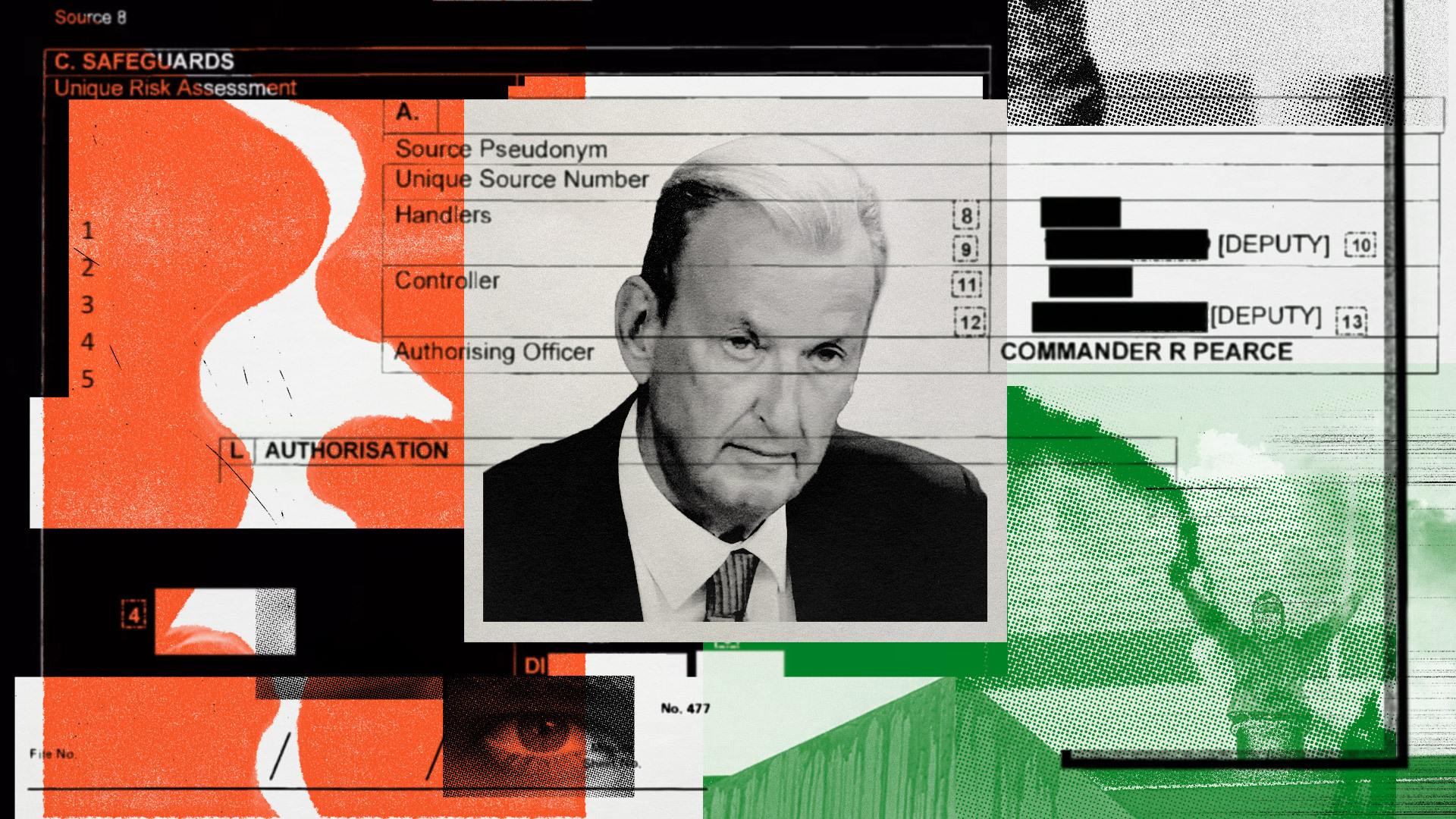
A former spycop who once led the Metropolitan police’s special branch has said that in some instances undercover officers could be authorised to have sex with Palestine Action activists.
Roger Pearce, head of the controversial counter-terrorism command from 1999 until 2003, told the ongoing ‘spycops’ inquiry that sexual relationships could be authorised as “a means of infiltrating activity involving, for example, a breach of military bases with an intention to inflict serious economic damage on, as we’ve seen recently… [an] aircraft”.
“I’m contemplating, for example, a breach of a factory making a particular product,” he continued, “to damage equipment in that factory and going equipped with, for example, sledgehammers with which you may injure a police officer.”
These examples appear to refer to two actions carried out by Palestine Action: one in which activists allegedly broke into RAF Brize Norton and spray-painted planes; the other in which a group damaged Israeli military assets at a Bristol factory, with one activist, Samuel Corner, striking an officer with a sledgehammer (Corner was later convicted of grievous bodily harm without intent).
“I’m using existing examples which we have seen reported recently, or fairly recently, as the kinds of things which might justify that authorisation,” Pearce told an inquiry evidence hearing on 15 July.
Pearce said he believed he had the power to authorise sexual relationships when he was in charge of special branch, but that no officer had ever asked him for authorisation.
At least 25 undercover police officers are reported to have had sex with deceived members of the public between the 1970s and 2010, including four who fathered, or are alleged to have fathered, children with women they met while working undercover.
In a witness statement given in 2013, Pearce listed criteria that would need to be considered to determine when, if ever, it would be acceptable for an undercover police officer to engage in a sexual relationship, which included “risk to the officer”, “risk to the operation” and “likely intelligence benefits from continuance (especially where serious crime is anticipated)”.
Asked in the inquiry evidence hearing in July if there was any other document listing criteria for judging whether authorisation might or might not be provided, Pearce said the “closest parallel” was the College of Policing’s 2012 guidance on undercover policing.
A spokesperson for the Met told Novara Media: “We are aware of these comments, however this [Pearce’s interpretation of the guidance] is inaccurate and we rebut this.
“The conduct described would not be authorised and having a sexual relationship is not an undercover policing tactic. This is covered in the College of Policing Authorised Professional Practice.”
When approached by Novara Media, the College of Policing insisted its current guidance was “clear” that sex “must not be used as an undercover policing tactic, nor should it be authorised as a means of gaining intelligence”, and that contrary to Pearce’s comments, “the guidance does not provide a route to authorise such a relationship”.
The guidance does, however, suggest that having sex while undercover could be justified if an officer “perceive[s] an immediate threat to themselves and/or others if they were not to do so”.
Pearce himself declined to comment on his remarks in July to the inquiry.
The Met would not confirm or deny if undercover officers still operate within political groups.
The undercover policing inquiry is an independent public inquiry looking into the activities of undercover officers in England and Wales who spied on more than 1,000 political groups, most of them leftwing and social justice organisations, from 1968 onwards.
Commissioned by then home secretary Theresa May in 2014 following the disclosure that police had spied on the family of murdered teenager Stephen Lawrence, the inquiry has so far covered the activities of the Special Demonstration Squad (SDS), a unit which operated from 1968 to 2008 and with which Pearce himself was an undercover officer. To date, it has looked at how officers deceived women into sexual relationships, stole the identities of dead children, and colluded to blacklist trade unionists, amongst other acts exposed by journalists in recent years which have attracted widespread public condemnation.
In 2003, Kate Wilson was tricked into a relationship with undercover officer Mark Kennedy, who posed as an environmental campaigner under the alias “Mark Stone”. In her mid-20s, Wilson dated Kennedy for 16 months, and the pair moved in together. Now a campaigner with Police Spies Out of Lives, Wilson told Novara Media she was “shocked” by Pearce’s comments.
“We’ve established [in the inquiry] that there was a completely rotten culture that existed in Roger Pearce’s day,” she said. “[His comments suggest] that culture was perpetuated and… may well still exist today.”
The inquiry is yet to look at the management of the unit that deployed Kennedy, the National Public Order Intelligence Unit (NPOIU), which was active from 1999 to 2011, as well as the oversight of all other undercover policing operations from 1968 to the present day. However, in July, the Home Office launched a consultation on the future of the inquiry, citing concerns about its length and cost (lawyer Imran Khan has argued it is the Met which has made the inquiry slow and expensive). Campaigners fear this consultation is the start of an attempt to curtail the inquiry before it reaches more recent misconduct by undercover officers.
Pearce left the force years before Palestine Action came into existence. His testimony does not show that undercover officers have had sex with members of the group, but rather sheds light on the attitudes of a senior officer who was once in charge of covert operations.
However, campaigners have expressed fears that these attitudes have not been consigned to the history books.
Wilson said that the idea that what happened in the SDS was “historic” is “a comfortable one for the state”, but “the continuation of that kind of political policing is much less comfortable… they don’t want it to be investigated”.
“The fact that he [Pearce] was linking what happened in the SDS to what is happening in the activist world today… is really important,” she said.
The College of Policing told Novara Media it is “currently reviewing” its guidance and “will consider relevant developments, including recommendations arising from the ongoing undercover policing inquiry”. However, the Home Office consultation calls into question whether the part of the inquiry due to cover such recommendations will even take place, Wilson argued.
Since retiring from the police, Pearce has embarked upon a twilight career as a spy fiction writer. His website claims his books draw on “his knowledge and first hand experience of a career in national security at every level”.
In one book – Agent of the State, published in 2012 – an undercover police officer using the fake name “John Corley” deceives a leftwing activist into a sexual relationship – actions one character describes as “fucking for Queen and country”. (Pearce himself operated under the fake name “Roger Thorley” whilst undercover within anarchist groups in the 1980s.)
Asked about this wording as part of the spycops inquiry in 2024, Pearce denied that “fucking for Queen and country” was how he perceived undercover police officers who had sex with activists, and that the storyline was merely “a work of fiction from my imagination”.
Police Spies Out of Lives and the Campaign Opposing Police Surveillance have called for a boycott of the consultation on the inquiry, claiming it is “rigged”, and instead asking those concerned for the inquiry’s future to write to the Home Office directly.
The consultation will run until 20 September.
Clare Hymer is head of articles at Novara Media.
Sam Knights is a writer and activist.