Thailand’s Anti-Israeli Protest Wave Isn’t About Palestine
‘Take Thailand Back.’
by Kullathida Krajangkul & Elliot Lodge
8 October 2026
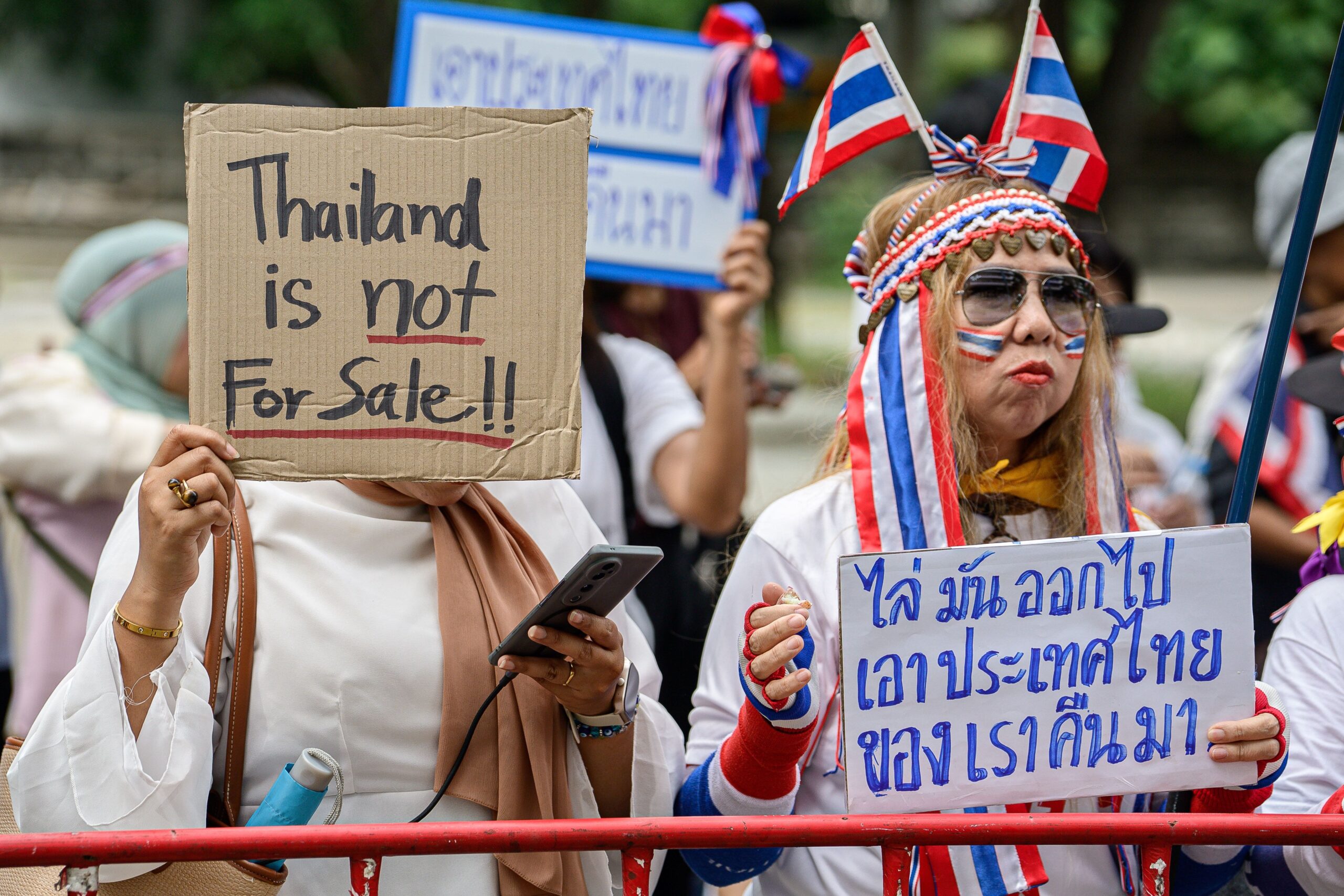
On a hot and humid morning in early September, hundreds of people gathered outside the Israeli embassy in Bangkok. While a few carried familiar symbols of Palestinian solidarity – a flash of red, black, white and green here, a watermelon there – a far greater number came carrying Thai flags. For every placard demanding an end to the genocide, or a boycott of Israel, many more bore nationalist statements, from “Thailand is not for sale” to the openly antisemitic “You Jewish folks don’t understand Thai culture, so get out”.
Thailand has been awash with anti-Israeli sentiment over the past few weeks, resulting in unprecedented mobilisations in the capital and on the country’s largest and most touristic island, Phuket. While Palestine solidarity has played a small part in these protests, they have mostly been organised by prominent rightwing agitators calling on supporters to “take Thailand back”.
Unlike in other parts of the world, where protests condemning Israel’s ongoing genocide in Gaza and occupation of the West Bank have become a mainstay of progressive politics, until recently, few Thais seemed interested. Palestine solidarity was the quiet work of Muslim communities, a handful of student and left activists, and a small number of campaigning organisations.
In one fortnight, the right mobilised more Thais against Israel than years of solidarity campaigning had managed.
‘My money builds your country.’
Israeli tourists, many of them recently discharged soldiers seeking a dose of tropical hedonism and escape, have long been a cause of consternation for Thai locals. In the past few years, as Israeli tourists have arrived in ever greater numbers, reaching a record 405,000 in 2025, hotspots such as the backpacker village of Pai in the north and the island of Koh Phangan have been visibly transformed by the influx, with entire parts of town now catering almost exclusively to the Israeli market.
Labour, meanwhile, runs the other way. Some 65,000 Thais are currently working in Israel, most of them on farms, in jobs once done by Palestinians. Since October 2023, when Israel suspended the permits of more than 100,000 West Bank workers, it has leaned on Thai labour harder still. “They’re trying to prevent Palestinians from getting jobs in Israel,” said Saowaluck Phothingam of Socialist Worker Thailand. “The way they do that is by importing foreign labour instead.” It’s “a problem of inequality” Saowaluck added. Thais go to Israel to do the work Palestinians are no longer permitted to do; Israelis come to Thailand to be served.
Reports of Israeli tourists behaving badly regularly surface in Thai media, with almost the entire country now seeming to have watched a video that went viral last year, of an incensed Israeli tourist telling a worker that “my money builds your country”, after she was asked to take her shoes off in a restaurant.
It isn’t just Israelis upsetting the locals. Despite Thailand’s significant reliance on tourism revenue, anti-foreigner sentiment is on the rise more generally. In one of a spate of recent incidents, a group of Italian students were forced into a public apology in late July. Their crime? Being loud and inconsiderate on public transport. Yet Israelis have become a particularly problematic category of foreigner in the public imagination, with attention shifting from individual misbehaviour to Israeli-owned businesses.
And it’s true that something more organised than backpacking has grown alongside the Israeli influx. On Koh Phangan, for instance, one in seven registered companies now has Israeli shareholders. One of these businesses is a centre called David’s Circle, which had taken in more than 900 Israelis by last May, about half of them discharged soldiers. Its founder, the trauma specialist Yael Shoshani-Rom, told the Times of Israel she wanted “something like a Chabad house, but therapeutic”, a reference to the Orthodox Jewish outreach centres that follow Israeli backpackers around the world. David’s Circle runs in partnership with Let’s Do Something, a nonprofit founded by friends of a young Israeli murdered at the Supernova festival, which also produces pro-Israel content and invests in what it calls “next-generation defence solutions”.
For most Thais, concern about whether Israeli businesses actively support genocide is secondary to a more generalised anxiety about foreign investment and “grey” capital – the Chinese and Russian money linked to illicit activities such as scam call centres. Alongside heavy scrutiny of land held by Israelis through nominee companies – Thai front companies used by foreigners to circumvent ownership restrictions – there has been a recent focus on the proliferation of Chabad houses, and frequent friction with those who run them. In July, an inspection of a Chabad house in Phuket accused of operating outside of the law went viral after a man inside reportedly asked officials: “Don’t you know that this is Israeli territory?“
“Grey Chinese” was already common currency for foreigners running businesses outside the law, amid growing scrutiny of Israeli businesses “Grey Jew” has now emerged as an extension of this label. While concerns about disregard for Thai law and culture are often substantiated, the grievance is about Israelis, and Thai has an ordinary word for them, yet the label that caught on reached instead for “Jew”. That slide, from a nationality to a people, runs through the rhetoric of the movement now leading the protests. One only has to look at its origins – and its originators – to understand why.
‘Protecting Thais.’
Former media mogul Sondhi Limthongkul is notorious in Thailand for leading the ultra-royalist “Yellow Shirt” movement against Thaksin Shinawatra, which helped pave the way for the 2006 military coup. In the years since, he has spent time in prison and remade himself as a YouTube talk-show host.
At the 10 September protest, the 78-year-old agitator took to the stage to read aloud from an open letter to the Israeli ambassador. In it, he spoke briefly about Palestine, before quickly pivoting to the need for foreigners to “respect and abide by Thailand’s laws and traditions”.
Ever the opportunist, Sondhi likely saw anti-Israeli sentiment as fertile ground to catapult himself back into the national spotlight. He has now effectively weaponised the public mood as part of his nationalist appeal to Thais perpetually concerned about sovereignty and outside influence – and the moment favours him.
Back in February, the country elected the populist rightwing prime minister Anutin Charnvirakul, a construction tycoon who built his brand on petty nationalism. The border conflict with Cambodia that broke out in 2025, still unresolved and having left hundreds dead, has produced a surge in brazen expressions of nationalism and militarism across the country.
The case of another business tycoon turned social media influencer brings much of this into focus. Sai Scott, the 30-year-old heir to the Singha empire, is a symbol of how many young Thais have latched on to this new politics of nationalism. With a million followers on Instagram and 1.3m on Facebook, Scott has established an emergent political brand based on “protecting Thais”. Last month, he racked up headlines for railing against Myanmar hospitality workers who could not speak Thai. Labourers from Myanmar, many of whom come having fled conflict, form a crucial yet easily exploited part of the Thai economy, fulfilling jobs Thais will not do. He then joined the Israel protests wearing a keffiyeh. “Get the fk out,” was his message to the ambassador. “We don’t want you here.”
“We’re a nation of peace,” he added, “but we’re not scared to kick your ass.”
‘A coincidental convergence.’
There were plenty of Thai leftists in the crowd on 10 September, and members of Palestine solidarity groups attended in a personal capacity, but none of their organisations put their name to the day.
Mook, an organiser with the Solidarity Collective, told Novara Media that she can see what the protest wave offers, noting scrutiny of Israeli visitors that did not exist before. But the sentiment, she argued, “doesn’t come from an understanding of settler colonialism, doesn’t come from an understanding of humanity. It comes from nationalist sentiment, from xenophobia, from hating the other,” combined with people feeling economically squeezed. What looks like an alignment is “a coincidental convergence”, she said. “Palestine has had its land taken because of Zionist Israeli nationalism,” she added, “so if you’re just going to fight that with Thai nationalism, what exactly are you actually helping with?”
Back when anti-Israeli feeling first flared on the islands, the Solidarity Collective agreed that they would not endorse it, on the grounds that it could come back to hurt their own movement.
Dr Adisara Khatib, the chairperson of Palestine Solidarity Campaign Thailand (PSC-T), said she stayed away too. “We didn’t know what Khun [Mr] Sondhi would say, so we didn’t want to bring PSC[-T] into it,” she said. PSC-T is “not a political organisation”, she added, “but an organisation fighting for humanitarian causes”. On the colour-coded factionalism of Thai domestic politics, it takes no side, though it continues to criticise the government over visa policy.
The demands for Israeli accountability, now being shouted outside the embassy, had already been made by PSC-T through the proper channels without any traction. In August last year, the group submitted a letter to the speaker of parliament, six months in drafting and co-signed by 31 organisations, calling for the screening of Israeli nationals entering the country, a suspension of Thai labour exports to Israel, an end to arms deals and the severance of diplomatic relations.
Drawing on the Hind Rajab Foundation’s database of suspected Israeli war criminals, PSC-T named two men tracked into Thailand and reported to the Royal Thai Police, the Ministry of Justice and the Thai embassy in The Hague, but no agency responded. These men, the letter states, “continue to enter Thailand freely, without visas, enjoying leisure in our country without any accountability for their heinous crimes.”
‘Rising antisemitic rhetoric.’
The leftwing organisers Novara Media spoke to fear Gaza is being used as a convenient tool in a larger political game, by actors whose politics depend on a narrow, racialised, blood-and-soil nationalism. In their statements it appears tacked on to a litany of other grievances. The language of war crimes and genocide has become just another stick to attack Israelis with, rather than an issue deserving the utmost seriousness and principled condemnation. And this kind of racial licence, Mook pointed out, “never really stays confined to just one group”. It spreads to Burmese people, then Cambodians, then southern Thai Muslims: the millions of migrant workers, marginalised and displaced people already being targeted by nationalist figures like Sai Scott.
The conspicuous spectre of antisemitism at recent protests is another complicating factor for the Thai left, who are aware they must remain vigilant to distinguish their analysis as criticism of the state of Israel. Adisara and other activists are at pains to insist that the Israeli government speaks for Zionism and not for Jewish people anywhere. But their discipline is being drowned out by the looser pronouncements of the new nationalist coalitions. On 15 September, US special envoy on antisemitism, Rabbi Yehuda Kaploun, took to X to say he was “deeply concerned by rising antisemitic rhetoric in Thailand”. He is not wrong when it comes to the language of the placards and the problematic label “Grey Jew”.
PSC-T “has to be careful not to be extreme nationalists”, Adisara said. Its charter commits it against racial discrimination, she added: to use a slur against Jewish people would be, in her analogy, like using one against a Black person.
That Israel and Israelis are now being targeted not out of solidarity with Palestinians or a commitment to human rights, but out of nationalist fervour, poses hard questions for the movement, not just on whether to participate in the protests, but on what its own work has achieved.
For Mook, 10 September brought resignation rather than shock. She knows she can’t outmatch the nationalists: serious work on Palestine in Thailand has long been done by a handful of familiar faces with a fraction of the resources of the nationalist right. But there is a positive aspect to the protests too: more Thais now know about Israel’s crimes and the violent IDF soldiers who frequent their shores. What this has created, Mook said, is a new opportunity to put a parallel narrative across: her aim now is to use the attention Sondhi has drawn to explain the situation in Palestine, rather than riding the anger.
Kullathida Krajangkul is a journalist and activist.
Elliot Lodge is a lecturer in social science at Chiang Mai University.