What Can Antifascists in the UK Learn From Antifa in the US?
The masks are off.
by Dan Clayton
16 April 2026
There’s always a ‘boy who cried wolf’ risk to announcing that fascism is here. But when you’ve got a US administration whose social media channels are, in the words of Christopher Mathias, author of To Catch a Fascist, “tweeting out straight-up Nazi propaganda, using words like ‘replacement’ and ‘remigration’ that were used by Nazi groups ten years ago and talking in explicitly white nationalist terms”, and even The Atlantic is saying “Yes, It’s Fascism” – then just maybe we are already there.
As Mathias put it when we spoke at the end of March: “We are in a completely mask-off fascist moment.”
The problem with trying to define fascism, the stage of it we have reached and whether we should even be using the f-word, is that rather like the apocryphal frog in boiling water, we are all gradually being boiled alive – being acculturated into fascism as it happens all around us. If we are waiting for a defining moment, it might be worth remembering the words of antifascist punk icon Thomas ‘Mensi’ Mensforth of The Angelic Upstarts, who reminded people in 1993 that “fascism doesn’t start with concentration camps; that’s where it ends”.
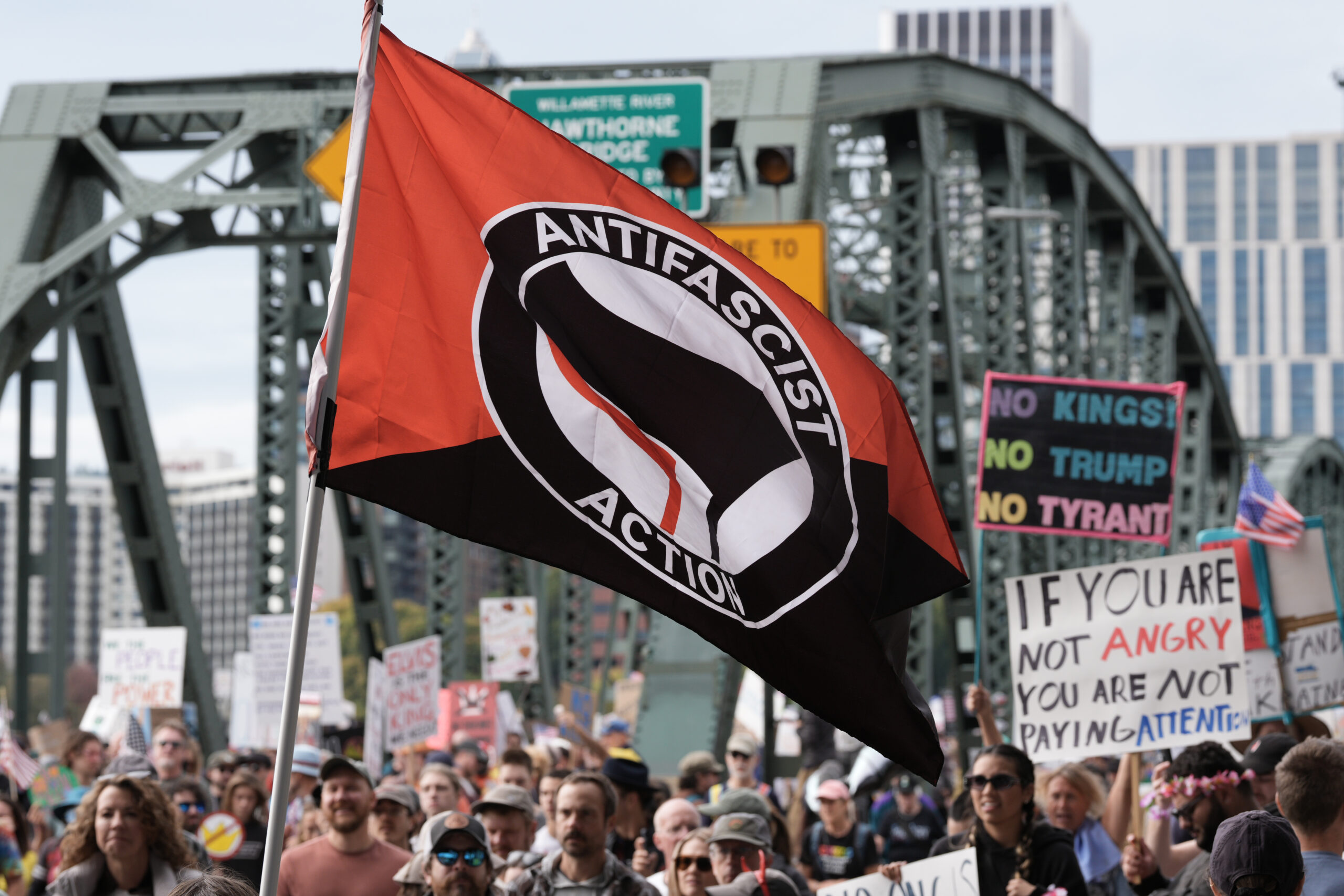
Antifascists in the US haven’t hung around waiting for the rest of the world to decide, and Mathias’s new book tells the story of a hidden war waged by antifa against the far-right, mostly removed from the street confrontations of old and more, as he puts it, on “the bulk of the work they actually do – intelligence gathering, research, espionage and identifying, unmasking, doxing thousands of members of this new fascist movement in America”.
Mathias defines antifa as “a decentralised, underground network of largely anarchists, socialists and communists, dedicated to destroying the far-right by any means necessary”. Much of its activity has involved removing masks to reveal the identities of those behind race attacks, uniformed marches, vandalism, and violent propaganda and rhetoric, but Mathias explains that there is a grim irony here too. “In previous eras in America when you wore a mask in organised fascism,” he said, “you did so in hopes of creating a world in which you won’t need a mask at all.”
So what happens when that world has been created, and the masks are truly off? And what are the lessons for UK antifascists as we face perhaps the most significant far-right threat since the late 1970s?
In some ways, we’ve been here before. The UK tradition of antifascism offered a template to US counterparts in the early 1990s, in terms of street activism, mass mobilisation and intelligence gathering. In decades prior, movements such as the Anti-Nazi League and Rock Against Racism that brought hundreds of thousands out on to the streets against fascism were a big part of 1970s activism. Red Action, Anti-Fascist Action and autonomous antifascist groups in Germany and Italy were direct influences on US antifa’s precursors Anti-Racist Action and the Minneapolis Baldies before them. And that tradition goes back through the 62 Group, the 43 Group (Jewish ex-servicemen who confronted postwar British fascists), and the original antifascists who both confronted the rising tide of fascism and Nazism in Germany and Italy in the 1930s and 40s, and were first to be targeted as fascism took power.
But like in the UK, where the dawn of CCTV and mass surveillance signalled an end to the street confrontations that had defined many of those groups’ street-level activities, the US has seen something of a decline in direct confrontation from antifascists and a shift into more community-based organising and intelligence gathering.
This is not new to antifascists in the UK, and at various points over the last few decades, we’ve seen intelligence work done by Searchlight, Hope Not Hate and Red Flare, identifying far-right activists, applying political and legal pressure on their organisations, and disrupting and undermining their work as much as possible.
It’s this last element that offers a key focus for Mathias and his book includes compelling stories of infiltration into the far-right, what was unearthed and how it was used. In one case, ‘Vincent’ infiltrates Patriot Front – a Nazi-worshipping group responsible for racist graffiti, provocative marches in paramilitary gear and banner drops over bridges – for five months. He shares with various antifascist researchers a trove of intel, including screenshots of private chats, audio, and photos and videos taken while he was the group’s official photographer. These lead to a steady stream of doxes: the identities of these hitherto secretive and anonymous fascists brought out into the open.
In another undercover operation, antifascist spy ‘Will’ infiltrated Identity Evropa – one of the organisations responsible for the deadly Charlottesville Unite the Right rally in 2017 – gathering “reams of data, of their messages and the memes they were sharing… evidence of their murderous intent for that day”.
Mathias describes it as “a seemingly unending scroll of unadulterated bloodlust and explicit plans for violence”. Following the rally, in which 32-year-old paralegal Heather Heyer was murdered by a self-identified white supremacist and dozens more injured, a lawsuit against the organisers of the rally drew heavily on the gathered data, leading to the dissolution of Identity Evropa and the doxing of many others involved.
By its very nature, doxing relies on what Mathias describes as “existing societal taboos against explicit racism, bigotry, white supremacy and fascism”. It uses those taboos to create “a social cost for being part of organised fascism”. Naming and shaming requires a modicum of well… shame – so how does that work when the fascist is dragged into the light, the mask is pulled off and the reaction is just a shrug of the shoulders?
We’ve already seen a gradual erosion of those taboos in the UK. Despite claims that they have tightened up their vetting procedures, Reform UK is still experiencing a steady trickle of scandals involving activists and candidates – with two examples making headlines in the past week alone. In Manchester, Adam Mitula is reportedly still listed as the election agent for three of Reform’s candidates ahead of the May local elections, after he was suspended as a party member over racist and antisemitic comments. In Essex, tanning salon owner and former Reform branch treasurer Aaron Taylor played the “it’s likely I’ve had a beer” card when confronted by the Mirror over his pro-Hitler posts.
Mathias believes doxing remains a powerful tool, as a way “for communities to know who among their neighbors has these beliefs because they pose a threat: they could commit violence”. For example, when the Charlottesville white supremacists were unmasked, among their number were a US marine, an employee for a major defence contractor staffer with government security clearance, and a middle school teacher from South Carolina.
One of the lessons for antifascists in the UK from Mathias’s book is the need to maintain a social cost for fascism and an explicit taboo against it. While it might feel like the tide is rising against us, there remains a widespread revulsion for the words and deeds of fascism, and spelling out exactly what people really believe in their most unguarded moments does still have the power to shock even a complacent public.
In the wake of US president Donald Trump’s immigration crackdown, where Immigration and Customs Enforcement (ICE) agents shot and killed unarmed mother Renee Good in Minneapolis in January, and Customs and Border Protection officers shot and killed intensive care nurse Alex Pretti just weeks later, Matthias calls it “telling” that “a lot of antifascist work has moved into identifying these masked ICE agents, creating a social cost for being a part of ICE”. That linking up of what can often be seen as a narrow antifascism with wider antiracist and class politics and organising, seems an important step for antifascists both in the US and here. Mathias makes the point that “what happened in Minneapolis was an uprising against ICE which had a lot of militant antifascist elements but wasn’t necessarily under the banner of antifa”.
Behind many of the doxes are activists prepared to put their lives on the line – and that kind of work has been going on in antifascist circles across the world for decades – but behind them are a less visible, but no less remarkable, group, who sift through the data, pinpointing locations, identifying types of shoe or parts of tattoos. Some antifa work involves setting up or supporting new forms of media to reach different people and bypass the monopolies consolidated by old media barons and newer tech giants, or dealing with sympathetic journalists in the mainstream to spread the word.
Mathias notes the role of websites like Unicorn Riot but also people working and talking together in their own communities. Those kinds of networks are hugely important, especially as big tech is also bending the knee to the far-right, with a report in The Intercept suggesting that Meta has imposed new rules that would censor posts mentioning ‘antifa’ alongside another “threat signal”, effectively banning someone from mentioning antifascism and the Battle of Cable Street or even World War II.
It’s clear too that much of this is rooted in communities. Just as the original Minneapolis Baldies kicked off because Nazis encroached on their scene and their community, anti-ICE activists in Minneapolis came together with their neighbours and friends to push back and defend themselves and each other. It’s sometimes said that when America sneezes, the world catches a cold. Maybe now that the US has a full-blown case of the flu, if we study the symptoms that antifascists across the Atlantic have identified – and at least some of the remedies they’ve been using – we can be better prepared for the years ahead.
Dan Clayton is a linguist, writer and editor in the education sector.