Why France’s Student Protesters Won’t Back Down
‘They have very little to lose.’
by Olly Haynes
20 October 2026
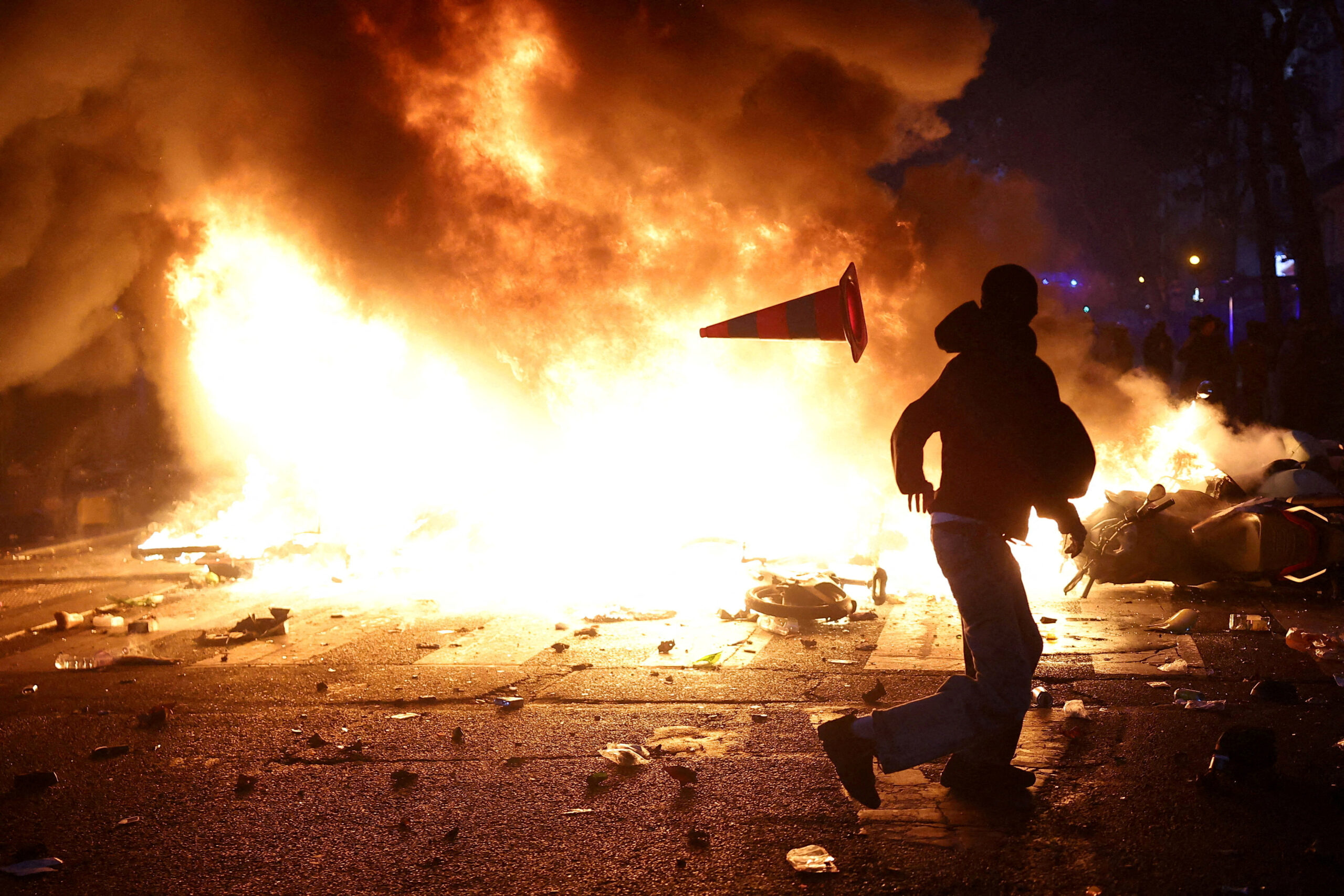
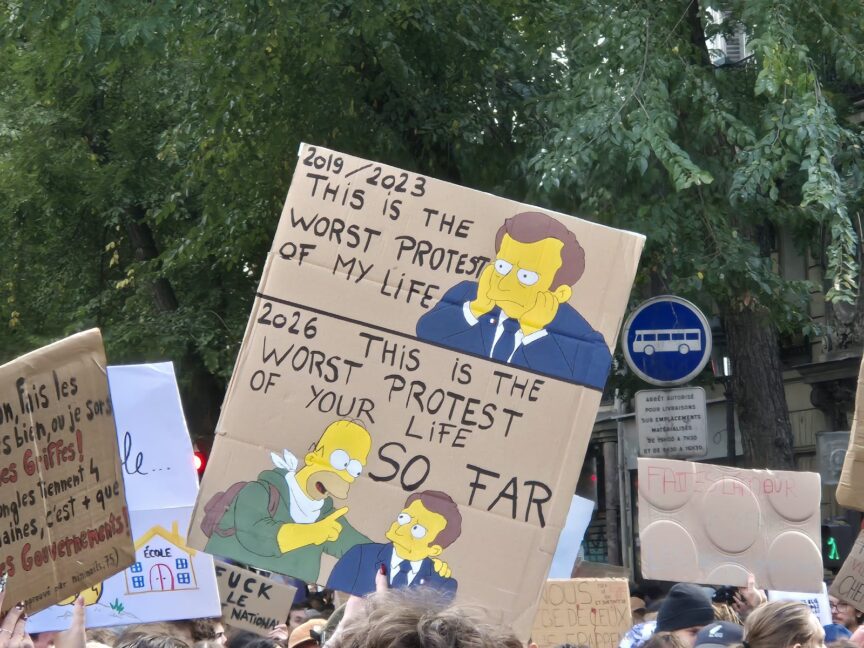
On Sunday in Paris, crowds filled the major squares and thoroughfares of Place de La Republique, Boulevard de Magenta and beyond. Flares were lit and the flags of France, Palestine, political parties and unions adorned the crowd. In one placard, a hand drawn Homer Simpson told President Macron that disturbances in 2019 and 2023 were just the worst protests of his life “so far”, indicating that the movement does not intend to lie down easily.
Students have been on the march or blockading their schools since 17 September, but this time they were joined by trade unionists and yellow vest protesters supporting student demands, protesting against the rising cost of living and rejecting the upcoming austerity budget. Anything between 550,000 (according to the interior ministry) and 800,000 people (according to the unions) took to the streets across the country.
The convergence of different movements that have erupted under the Macron presidency could be heard in the songs and chants of the crowd. There was “on est la” (“we are here”) the defiant song of the “yellow vest” movement, chants of free Palestine, as well as adapted versions of songs against Macron’s pension reform which were recycled to apply to education.
While the majority of the protests have occurred peacefully since the movement began, there have also been dramatic clashes with police. Violence has largely characterised the police response so far. A rubber bullet and tear gas left two students blinded. A grenade left one with a severed hand and a tear gas canister fired directly into a 15-year-old’s face left him with a broken jaw. Thousands of people have been arrested, the majority of whom are minors.
Many have questioned the police tactics and their role in escalating the disorder. On Sunday in Paris, a youth orchestra formed to promote climate justice was tear-gassed in the middle of a rehearsal at Place de La République, setting the stage for the square to become the site of pitched battles between police, protesters and rioters for the rest of the day. Shops on the square had their windows smashed in and cars were burned by “casseurs” (vandals) who used the protests as an event to fight the police.
Instances of violence and looting have accompanied the protests, though often not from students – according to figures released by the Justice Ministry, the majority of those arrested following the looting on 17 October were adults, in contrast to the arrests at previous protests. There have also been sporadic arson attempts at certain schools, and instances of violence. Generally – but with some exceptions – these have not come from the students at the schools in question, but young people who had come from outside.
‘Bismillah, c’est les tenebres.’
On Boulevard de Magenta, just off Place de la Republique, placards and slogans drew attention to a variety of demands and grievances ranging from the lack of teachers in schools, the suffocating heat of classrooms during the June heatwaves and the police violence.
A placard with a drawing of a chicken read “plus de masters, moin du poulet” (“more masters, less chicken”) – referring to the moral panic that occurred earlier this year about youth from the banlieue eating at fastfood chicken joints like Master Poulet.
“Watch your hands” read another, depicting a police grenade.
A recurring theme was the phrase “bismillah, c’est les tenebres” (“In the name of God, it’s the darkness”). The phrase doesn’t really mean anything, but it has become a ubiquitous meme. The phrase was mockingly reclaimed by protesters after it was allegedly used by police in a cack-handed attempt to mimic North African youth slang during an infiltration of protest groups on Snapchat. (One placard translated as: “bismillah, we want the name of the author of the punchline of the century”, referring to how widespread the meme has become.)
Novara Media spoke to several student protesters about why they were protesting and where the movement goes next. In France, the media usually does not print the surnames of minors, so accordingly all the students only gave their first names.
Camille and Nathan, both 17, from the Lycée Gabriel Fauré in Paris’s 13th arrondissement, have been blockading their high school for two weeks.
Camille described their school as “your average high school, not the least well off, but not rich either”.
Nathan said he wanted more teachers, better pay and conditions for teachers and teaching assistants and the removal of Pacoursup – the platform through which students apply to university, the algorithms of which have been accused of bias against students from poorer schools.
“We want more money for schools, because there isn’t enough. Whether that’s schools in Paris or schools in the banlieue because in France it doesn’t matter whether you are in Lycée Gabriel Fauré, or in Lycée Paul Éluard in Saint-Denis [a poor school that has particularly intense protests], we all have the same problem”.
Camille added that bad organisation of timetables was one of the issues that they were protesting against. “There are days where we finish at six in the evening. For some classes in year 13 they finish at 7pm,” she said. “There are also big holes in our timetable meaning we have periods of three or four hours where we do nothing but can’t leave. Sometimes I have extracurricular activities which finish at 7 o’clock or later, by the time you get home it’s 8 and then you have homework, so it’s difficult to have a life beyond school.”
Other demands of students have included fixing crumbling and leaking school buildings and fixing heating and adding air conditioning systems, so that school buildings are not freezing in winter and boiling in summer.
‘They have very little to lose.’
School holidays have started and politicians, commentators and even some students have been wondering whether the movement can sustain itself. Novara Media found several ideas and perspectives on where to go next among students.
Abraham, a student at Lycée du Château d’Épluches, where a student had his jaw broken by a police munition, told Novara Media that “as young people, that incident scared us, and it spread fear among the students [at his school]”.
Nonetheless, “we will continue”, he said. “I’ve already heard of preparations for after the holidays. If our demands aren’t met and our rights aren’t respected, then we will continue the blockades until they are.”
Felix, a spokesperson for L’Union Etudiante, a major student union, said, “We are in such a state that emergency measures need to be implemented.” The union has formulated ten key demands, including a cancellation of the proposed restrictions to access housing benefit which lots of university students rely on, the ending of university selection through algorithmic platforms Parcoursup and a renovation of school and university buildings.
Students need “to have a better future, to emancipate themselves, so they can study without the roof falling in on them”, he said.
“We expect there to be lower energy during the holidays”, he added, but said that the union would “restart mobilising as soon as holidays were over, because the detestable conditions students find themselves in won’t have changed”.
Stathis Kouvelakis, a political philosopher and activist who studies political cycles and social movements, told Novara Media that the current protests are “not like a strike. In a strike you lose a lot, because there is a financial cost. That makes mobilisation quite a tough thing. But students? They have very little to lose.”
But now, workers and yellow vest protesters have joined the students. Gwen, a student from Lycée Romain Rolland in Ivry-sur-Seine, saw potential for spreading action beyond the student body. She said: “We want to talk to the workers, the teachers and all so that they can block other places like the RATP transport network” – referring to the public transport system in the Île-de-France region. “If we can block that, the government will get really fucked up.”
Olly Haynes is a freelance journalist covering politics, culture and social movements.